Why Almost No Criminal Cases Go to Trial, and How Plea Bargaining Decides Them Instead
By MHB Admin ·
The American criminal trial is one of the most familiar institutions in the world. It fills courtroom dramas, true-crime podcasts and civics lessons. It is also, statistically, close to disappearing. In the federal courts, about 97 of every 100 people sentenced in a recent year were convicted by guilty plea. In the state courts, where most criminal cases are heard, jury trials account for a small fraction of criminal case dispositions in most states with available data.
This is not a secret, and it is not new. In 2012, writing for the majority of the US Supreme Court, Justice Anthony Kennedy wrote that "criminal justice today is for the most part a system of pleas, not a system of trials." What is less widely understood is how that system works: what is negotiated, by whom, with what leverage, under what legal rules, and what the evidence says about its effects. Popular statistics on plea bargaining are also often quoted without the context needed to interpret them.
This article sets out the mechanics, the numbers and the evidence, focusing on the United States, where plea bargaining is most developed and best documented. Rules differ substantially between the federal system and the 50 states, and among states, and the article tries to note where they do.

The numbers, and what they actually measure
Statistics on plea bargaining are frequently repeated as if they all measured the same thing. They do not. The denominators differ, and so do the answers.
html
<table>
  <thead>
    <tr>
      <th>Statistic</th>
      <th>Jurisdiction and year</th>
      <th>Denominator</th>
      <th>Figure</th>
      <th>Source</th>
    </tr>
  </thead>
  <tbody>
    <tr>
      <td>Share of sentenced cases resolved by guilty plea</td>
      <td>Federal courts, fiscal year 2024</td>
      <td>61,678 cases sentenced under the federal sentencing guidelines</td>
      <td>97.2% guilty pleas; 2.8% trials</td>
      <td>US Sentencing Commission</td>
    </tr>
    <tr>
      <td>Outcomes for all charged defendants</td>
      <td>Federal courts, fiscal year 2018</td>
      <td>79,704 defendants whose cases concluded</td>
      <td>90% pleaded guilty; 8% had cases dismissed; 2% went to trial</td>
      <td>Pew Research Center analysis of federal judiciary data</td>
    </tr>
    <tr>
      <td>Acquittals</td>
      <td>Federal courts, fiscal year 2018</td>
      <td>All 79,704 defendants</td>
      <td>320 acquitted, fewer than 1%</td>
      <td>Pew Research Center analysis of federal judiciary data</td>
    </tr>
    <tr>
      <td>Share of convictions by plea</td>
      <td>Federal and state courts, as cited by the Supreme Court in 2012</td>
      <td>Convictions</td>
      <td>About 97% federal; about 94% state</td>
      <td>Missouri v. Frye and Lafler v. Cooper</td>
    </tr>
    <tr>
      <td>Jury trials as a share of criminal dispositions</td>
      <td>22 state court systems with data, 2017</td>
      <td>All criminal case dispositions</td>
      <td>Generally between about 1% and 3%</td>
      <td>Pew Research Center analysis of National Center for State Courts data</td>
    </tr>
  </tbody>
</table>
The differences are not trivial. The Sentencing Commission's 97% figure counts only people who were convicted and sentenced, so it excludes everyone whose case was dismissed or who was acquitted. The Pew figure of 90% counts all defendants whose cases ended, including dismissals. Both are accurate, but they answer different questions. One describes how convictions happen. The other describes how cases end.
State figures are even harder to pin down. There is no standardised national collection of state court data on how criminal cases are resolved. The best available comparison, compiled by the National Center for State Courts and analysed by Pew Research Center, covers jury trials as a share of all criminal dispositions in 22 state court systems in 2017. That figure was 0.86% in Texas, 1.11% in Pennsylvania, 1.25% in California, 1.53% in Florida, 2.12% in Michigan and 2.91% in New York. These figures include misdemeanours and all types of disposition, and states count cases differently, so they should be compared with caution. They are not "trial rates" in the same sense as the federal figures.
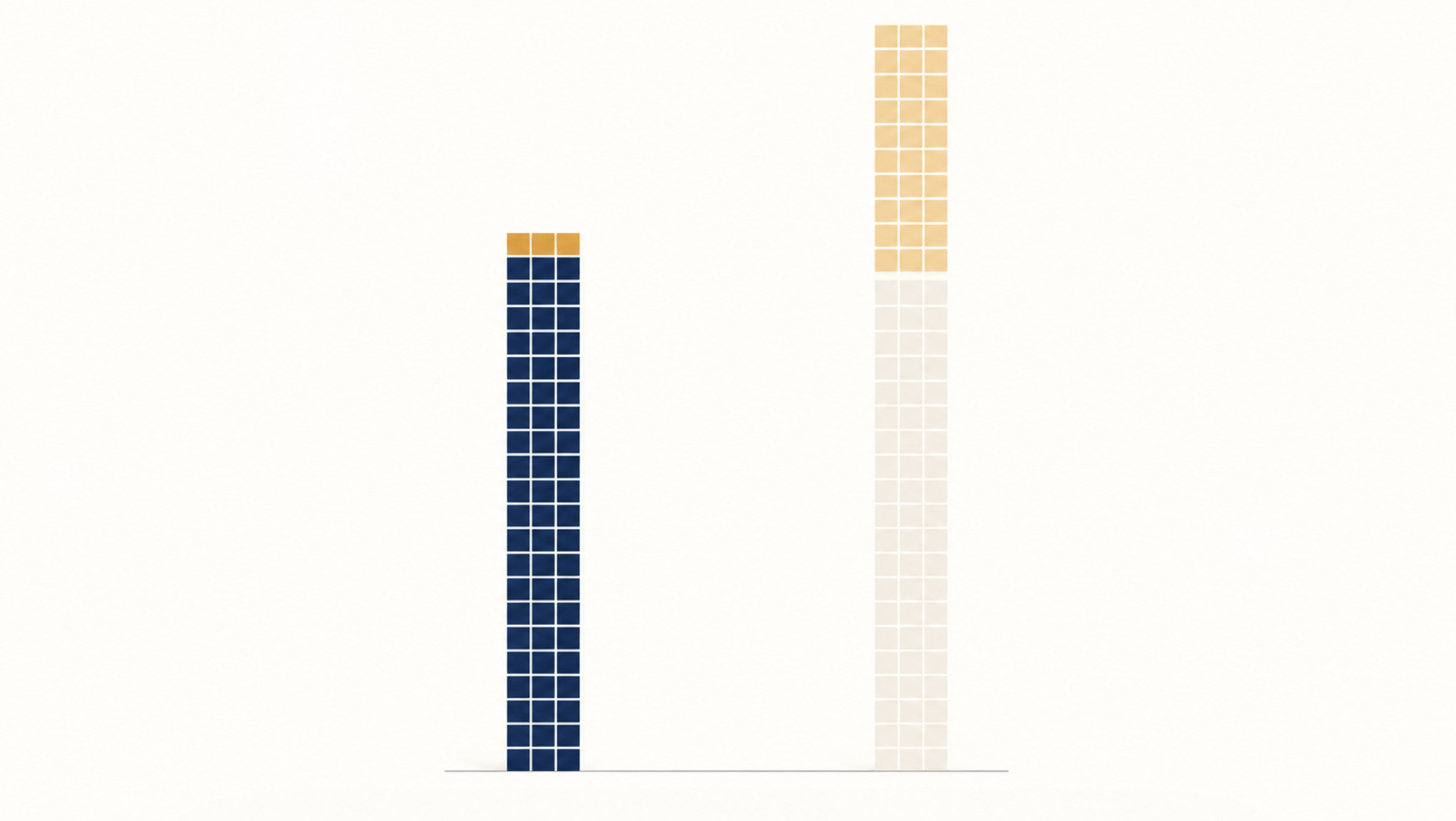
The federal trend is clearer. According to Pew's analysis, the share of federal defendants going to trial fell from 7% in fiscal 1998 to 2% in fiscal 2018, and the number of trials fell from 4,710 to 1,879. The share pleading guilty rose from 82% to 90% over the same period.
What gets negotiated
"Plea bargaining" covers several distinct kinds of agreement. The differences matter because they shift power between the prosecutor, the defendant and the judge in different ways.
In a charge bargain, the defendant pleads guilty to a less serious charge, or to fewer charges, than originally filed. A burglary charge might become trespass. Of five counts, four might be dismissed. Because the charge often determines the possible sentence, charge bargaining can be the most consequential form of negotiation, and it is controlled largely by the prosecutor.
In a sentence bargain, the defendant pleads guilty in exchange for a recommendation or an agreement about the sentence. Depending on the jurisdiction and the type of agreement, the judge may or may not be bound by it.
In a fact bargain, the parties agree on which facts will be presented to the court, for example the quantity of drugs or the amount of financial loss. Where sentencing rules depend on such facts, as they do under the federal guidelines, this can determine the sentence range.
In federal court, Rule 11 of the Federal Rules of Criminal Procedure governs plea agreements. It allows agreements in which the government agrees to dismiss charges, to recommend a sentence, or to agree that a specific sentence is appropriate. The last type binds the court if the court accepts the agreement, and the defendant can withdraw the plea if the court rejects it. Rule 11 also bars federal judges from participating in plea discussions. Many states follow similar principles, but the rules vary. Some states permit greater judicial involvement in negotiations, and states differ on how binding sentence agreements are.
The legal foundations
Plea bargaining is not mentioned in the Constitution. Its legal framework was built by a series of Supreme Court decisions, mostly in the 1970s, that accepted the practice and set limits around it.
In Brady v. United States (1970), the Court held that a guilty plea is not invalid merely because the defendant entered it to avoid the possibility of a harsher penalty, including the death penalty, after trial. The plea must be voluntary and knowing, but the incentive to plead does not by itself make it coerced.
In Santobello v. New York (1971), the Court held that when a plea rests on a prosecutor's promise, that promise must be kept. The decision described plea bargaining as an essential component of the administration of justice.
In Bordenkircher v. Hayes (1978), the Court went further. A Kentucky prosecutor offered a defendant charged with forging a check a five-year sentence recommendation if he pleaded guilty. The prosecutor told him that if he refused, the state would seek an indictment under the habitual offender statute, which carried a mandatory life sentence. The defendant refused, was convicted under the habitual offender law and was sentenced to life. The Court upheld the outcome, holding that the prosecutor had not violated due process by carrying out a threat made openly during negotiations, when the defendant was free to accept or reject the offer and the prosecutor had probable cause for the more serious charge.
In Missouri v. Frye and Lafler v. Cooper, both decided by 5–4 votes in March 2012, the Court held that the Sixth Amendment right to effective assistance of counsel applies to plea negotiations. Defence lawyers generally must communicate formal plea offers to their clients, and defendants who reject an offer because of deficient legal advice may be entitled to a remedy. These cases treated plea bargaining as a critical stage of a criminal case, the same as trial.
Together, these decisions established the modern framework. Prosecutors may offer substantial incentives to plead guilty and may threaten more serious charges if they are legally justified. Defendants must plead voluntarily and knowingly, with competent legal advice, and the government must honour its promises.
The trial penalty, and how it is measured
The term "trial penalty" refers to the difference between the sentence a defendant would receive after pleading guilty and the sentence after being convicted at trial. Some difference is built into the law. Under the federal sentencing guidelines, a defendant who "clearly demonstrates acceptance of responsibility" receives a two-level reduction in offence level. A further one-level reduction is available on the government's motion for defendants with higher offence levels who plead guilty in a timely way. Many state systems give credit for a guilty plea in similar ways, formally or informally.
The size of the penalty in practice is harder to measure than it looks. Defendants who go to trial differ from those who plead guilty. They may face more serious charges, have stronger defences or have received worse offers. A straightforward comparison of average sentences mixes the effect of going to trial with these underlying differences, which researchers call selection effects. Acquittals complicate the calculation further, because a defendant who is acquitted receives no sentence.
Criminologists have tried several ways to address this, including statistical controls for offence seriousness and criminal history, selection-correction models and experiments presenting identical hypothetical cases to court officials. A 2019 review by Brian Johnson, a criminologist at the University of Maryland, summarised the research. Across studies, conviction at trial was associated with two to six times higher odds of incarceration and sentences roughly 20% to 60% longer. In federal courts, after adjusting for other sentencing factors, trial sentences were typically about one-sixth to two-thirds longer. In one survey experiment, court officials given the same hypothetical robbery case assigned a ten-year sentence after trial and a six-year sentence after a plea. The review also noted that most studies may understate the penalty, because they miss earlier decisions such as charge reductions and discounts for cooperation.
The penalty is not uniform. Research finds it varies by offence type and jurisdiction, and some studies suggest it is larger where trials are rarer. The evidence also does not settle the normative question. Some argue a sentencing discount for pleading guilty is a legitimate reward for accepting responsibility and saving public resources. Others argue that a large enough gap pressures defendants to give up their right to trial. Both positions rest on the same evidence. The disagreement is about what level of incentive is appropriate.
What influences the decision to plead
The choice to plead guilty is shaped by more than the strength of the evidence.
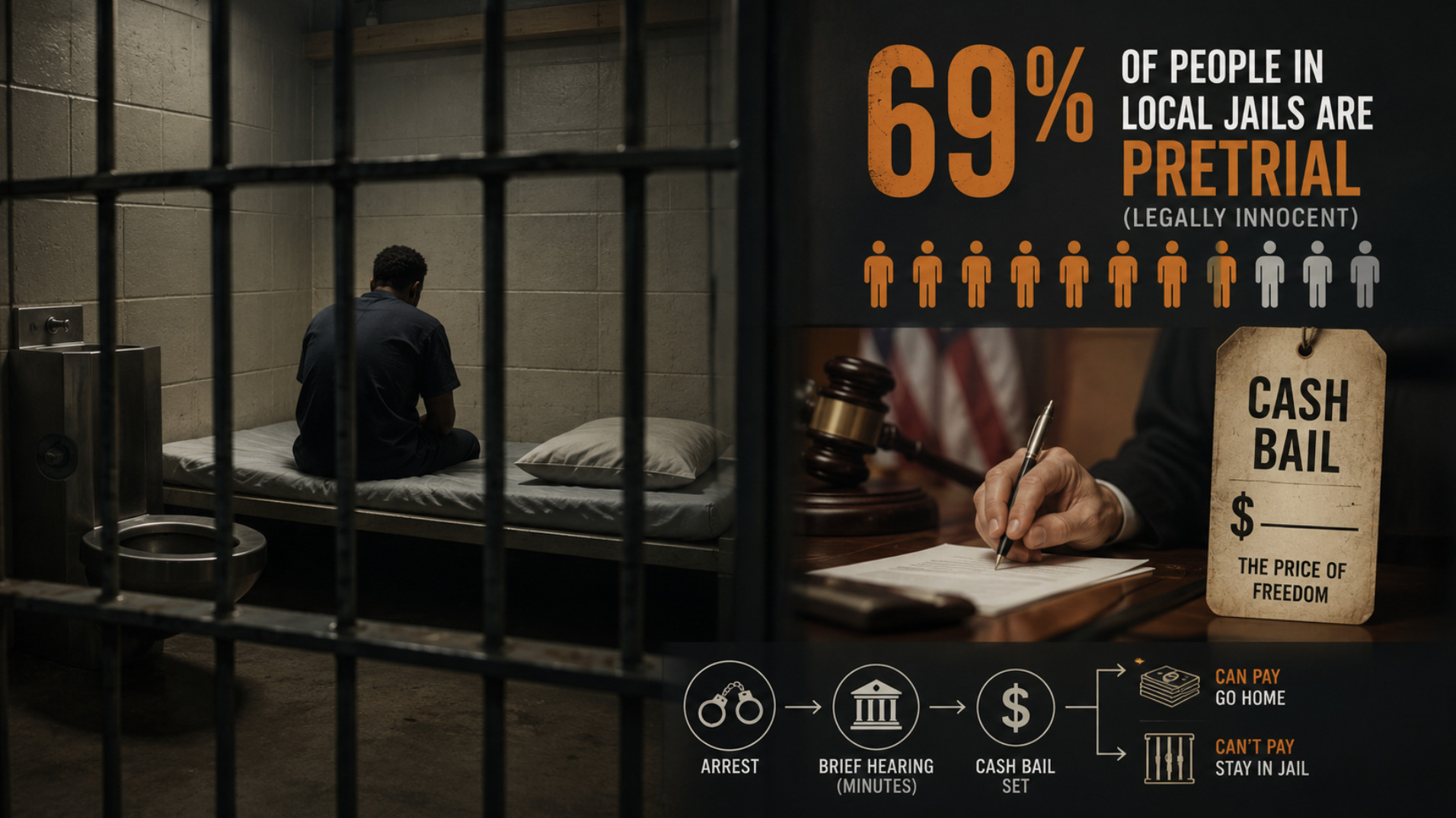
Pretrial detention is one of the most studied factors. A defendant held in jail while their case proceeds may face weeks or months in custody before trial, while a plea to a lesser charge may offer release with time served. Several studies have examined this using cases in which defendants were assigned to bail judges with different tendencies to detain. That design reduces the effect of differences between the defendants themselves. A study of misdemeanour cases in Harris County, Texas, by Paul Heaton, Sandra Mayson and Megan Stevenson, published in the Stanford Law Review in 2017, found that detained defendants were substantially more likely to plead guilty than comparable released defendants. Research by Megan Stevenson on Philadelphia reached similar conclusions, finding that pretrial detention increased the likelihood of conviction, largely through guilty pleas. These findings come from specific jurisdictions and periods and may not generalise everywhere. But they are among the strongest causal evidence in this field.
Charging decisions shape the bargaining position from the start. Where prosecutors can file charges carrying mandatory minimum sentences, or stack multiple counts, the gap between the offer and the possible sentence after trial can become very large.
Defence resources matter too. Most defendants in the US criminal courts are represented by public defenders or appointed counsel. High caseloads can limit the time available to investigate cases, review evidence and prepare for trial, which in turn affects how defence lawyers assess an offer.
Information is often limited at the plea stage. Rules on when the prosecution must share evidence with the defence vary considerably between jurisdictions. In some, defendants may be asked to accept an offer before receiving full discovery.
When innocent people plead guilty
Most people who plead guilty are presumably guilty of at least some offence. But the research record shows that some innocent people plead guilty too.
The National Registry of Exonerations, maintained by researchers at the University of California, Irvine, the University of Michigan and Michigan State University, records cases in which people convicted of crimes were later officially cleared. By its 2025 annual report, it had recorded 3,792 exonerations, including 3,767 from 1989 through 2025. Guilty-plea exonerations have been a persistent part of that record. In 2015 alone, the registry documented 65 exonerations of people who had pleaded guilty, a record at that time. Many of those cases involved drug charges in which later laboratory testing found no illegal substance. The Innocence Project has reported that about 10% of the people exonerated through DNA evidence in its earlier count had pleaded guilty.
These figures do not measure how often innocent people plead guilty. Exonerations are rare, depend on someone pursuing the case, and are far more common in serious cases where the stakes justify reinvestigation. Guilty pleas in lower-level cases, where sentences are short and the incentives to plead are strongest, are much less likely ever to be re-examined. What the cases do establish is that a guilty plea is not, by itself, proof of guilt. The incentives built into plea bargaining can lead innocent people to accept a certain, shorter sentence rather than risk a much longer one.
What changes when trials disappear
The decline of trials has consequences that reach beyond individual cases.
Fewer independent tests of evidence. A trial is the main occasion on which evidence is tested in public, witnesses are cross-examined and a judge or jury makes findings. When almost all cases end in pleas, police practices, forensic methods and prosecution evidence are examined far less often in court.
More discretion with the prosecutor. In a trial system, a judge or jury decides guilt and the judge decides the sentence. In a plea system, the prosecutor's charging and offer decisions often effectively determine both, subject to the judge's acceptance of the agreement.
Less public visibility. Plea negotiations take place privately, and many details are never recorded in public court files. Data on offers made, offers rejected and the differences between charges filed and charges pleaded are scarce. Researchers studying federal plea agreements have noted that key details of binding agreements are often not systematically collected.
A system built on volume. Defenders of plea bargaining argue that it allows courts to handle caseloads that would be impossible to try, gives defendants certainty, and lets prosecutors focus trial resources on the most serious or contested cases. Critics argue that the same features make the system depend on pressure rather than adjudication. Both describe the same structural fact: the court system as currently resourced could not function if a large share of defendants insisted on trials.
What reform proposals target
Proposals to change plea bargaining in the United States generally fall into a few categories. None is close to universal adoption, and their effects are contested.
Some proposals aim to increase information and transparency, by requiring earlier and fuller sharing of evidence before pleas, recording plea offers in the court record, or collecting data on offers and outcomes.
Others aim to reduce the incentive gap, by limiting mandatory minimum sentences, restricting charge stacking or capping the difference between sentences offered and sentences after trial.
Others focus on the conditions under which pleas are made, such as reducing pretrial detention for lower-level offences or reducing public-defender caseloads.
Some jurisdictions have experimented with greater judicial oversight of plea agreements, including judicial review of the factual basis for a plea and of whether the defendant understood the consequences.
The research base for these reforms is uneven. Pretrial detention has the clearest causal evidence linking it to guilty pleas. Many other proposals rest on the logic of incentives rather than on evaluations of implemented policies.
Reading plea bargaining statistics carefully
Because plea bargaining dominates the criminal courts, its statistics appear frequently in public debate. A few questions help interpret them.
Is the figure a share of convictions, a share of sentenced cases or a share of all charged defendants? The answers can differ by several percentage points.
Is it federal or state? Federal cases are a small fraction of all criminal cases nationally and differ in offence mix and procedure.
Does it include misdemeanours? Misdemeanour courts handle very large numbers of cases, often with very high plea rates and limited data.
Is a sentencing difference raw or adjusted? Simple comparisons of average sentences after trial and after plea mix the effect of going to trial with differences between cases.
The overall picture is consistent across data sources. In the United States, criminal cases are resolved overwhelmingly by negotiation rather than by trial, under legal rules that allow substantial incentives to plead. That system is efficient, deeply embedded and largely invisible. Understanding it is essential to understanding how criminal justice in the United States actually works, rather than how it appears on television.