How Much Microplastic Is Really in the Human Body, and Why Scientists Disagree
By MHB Admin ·
Over the past few years, microplastics have been reported in almost every part of the human body that researchers have examined: blood, lungs, placentas, testes, arterial plaque and, most strikingly, the brain. Headlines have suggested that people eat a credit card's worth of plastic every week and carry a spoonful of it in their heads. A 2024 study linked plastic particles in arterial plaque to heart attacks and strokes.
In early 2026, the picture became more complicated. Scientists publicly challenged several of the most prominent studies, arguing that the measurement methods could not reliably distinguish plastic from human fat. The challenges did not claim that microplastics are absent from the body or harmless. They argued that many reported quantities are uncertain, some may be substantially overstated, and the evidence linking them to disease is weaker than headlines suggest.
This article sets out what is known, how the numbers are produced, why they are disputed, and what can and cannot yet be concluded about the health effects.

What counts as a microplastic
Microplastics are generally defined as plastic particles smaller than 5 millimetres. Nanoplastics are much smaller, usually below 1 micrometre, small enough in principle to cross cell membranes and biological barriers. The two are often discussed together, but they behave differently and are measured differently. Most current methods are far better at detecting larger microplastics than nanoplastics.
Plastics enter the environment from the breakdown of larger items, the shedding of synthetic textile fibres, tyre wear, paints and coatings, and products that contain small plastic particles by design. People are exposed mainly by swallowing particles in food and drink and by breathing them in, especially indoors, where synthetic fibres from clothing, carpets and furnishings contribute to household dust.
Two ways of counting, and why they give different answers
Microplastics can be measured by counting particles or by weighing plastic, and the two approaches answer different questions.
Particle-counting methods use microscopes combined with spectroscopy, usually infrared or Raman, to identify individual particles and their polymer type. They give counts, sizes and shapes. They are reliable for larger particles but become slow and less reliable for very small ones, and most cannot see nanoplastics at all.
Mass-based methods break a sample down and measure the total amount of plastic. The most widely used is pyrolysis gas chromatography–mass spectrometry, usually shortened to Py-GC/MS. The sample is heated until its components decompose. The resulting fragments are separated and identified, and specific fragments are used as markers for particular plastics, such as polyethylene or polypropylene. This method can detect plastic regardless of particle size, including nanoplastics, and reports results in micrograms per gram of tissue.
html
<table>
  <thead>
    <tr>
      <th>Method</th>
      <th>What it measures</th>
      <th>Strengths</th>
      <th>Main limitations in human tissue</th>
    </tr>
  </thead>
  <tbody>
    <tr>
      <td>Microscopy with infrared or Raman spectroscopy</td>
      <td>Number, size, shape and polymer type of individual particles</td>
      <td>Identifies specific particles directly</td>
      <td>Cannot reliably see the smallest particles; slow; results depend heavily on lab procedures</td>
    </tr>
    <tr>
      <td>Pyrolysis gas chromatography–mass spectrometry (Py-GC/MS)</td>
      <td>Total mass of specific polymers in a sample</td>
      <td>Detects plastic regardless of particle size, including nanoplastics</td>
      <td>Breakdown products of fats and other biological material can mimic plastic markers, especially for polyethylene and PVC</td>
    </tr>
    <tr>
      <td>Electron microscopy</td>
      <td>Images of very small particles</td>
      <td>Can visualise nanoscale particles</td>
      <td>Does not on its own identify chemical composition</td>
    </tr>
  </tbody>
</table>
The choice of method can change the result by orders of magnitude, and comparing a particle count from one study with a mass concentration from another is rarely meaningful.
The studies behind the headlines
Several studies have shaped public understanding of microplastics in the body. They differ greatly in design and in what they can show.
html
<table>
  <thead>
    <tr>
      <th>Study</th>
      <th>Tissue and sample</th>
      <th>Method</th>
      <th>Main finding</th>
      <th>Key limitations</th>
    </tr>
  </thead>
  <tbody>
    <tr>
      <td>Leslie and colleagues, Environment International (2022)</td>
      <td>Blood from 22 healthy donors in the Netherlands</td>
      <td>Py-GC/MS</td>
      <td>Plastic quantified in 17 of 22 samples; mean about 1.6 µg/mL</td>
      <td>Small sample; method later questioned for biological interference</td>
    </tr>
    <tr>
      <td>Marfella and colleagues, New England Journal of Medicine (2024)</td>
      <td>Carotid artery plaque from 257 patients undergoing surgery in Italy</td>
      <td>Py-GC/MS, with electron microscopy</td>
      <td>Polyethylene detected in 58.4% of patients; those with detected plastic had a higher risk of heart attack, stroke or death over about 34 months</td>
      <td>Observational; critics questioned contamination controls and the use of blank samples</td>
    </tr>
    <tr>
      <td>Nihart and colleagues, Nature Medicine (2025)</td>
      <td>Liver, kidney and brain samples from deceased people in New Mexico, 2016 and 2024, with additional brains from earlier years</td>
      <td>Py-GC/MS, with infrared spectroscopy and electron microscopy</td>
      <td>Brain concentrations higher than liver or kidney and higher in 2024 than in 2016; highest in 12 people with dementia</td>
      <td>Associative; small samples; formally challenged over possible interference from brain fats</td>
    </tr>
  </tbody>
</table>
The 2024 carotid plaque study by Raffaele Marfella and colleagues drew particular attention. Among 257 patients who had plaque surgically removed from their neck arteries, polyethylene was detected in 150 (58.4%). During about 34 months of follow-up, patients with detectable plastic in their plaque had a substantially higher rate of heart attack, stroke or death from any cause, with a hazard ratio of 4.53. The study was observational. Patients with and without detectable plastic may have differed in ways that also affected their risk, and the plastic could be a marker of something else rather than a cause. The authors acknowledged that the study did not establish causation. Critics also questioned whether background contamination had been adequately measured.
The 2025 brain study by Alexander Nihart, Matthew Campen and colleagues reported median concentrations in frontal cortex samples of about 3,345 micrograms of plastic per gram of tissue in 2016 and about 4,917 micrograms per gram in 2024. That is roughly 0.3% to 0.5% of tissue weight, much higher than in liver or kidney. About three-quarters of the plastic detected in brain was polyethylene. Samples from 12 people with dementia had much higher measured concentrations. The authors were explicit that the findings were associative. Dementia itself, through brain atrophy and changes to the blood-brain barrier, could raise concentrations rather than the reverse. They also acknowledged that residual fats could affect the measurements.
Why the measurements are disputed
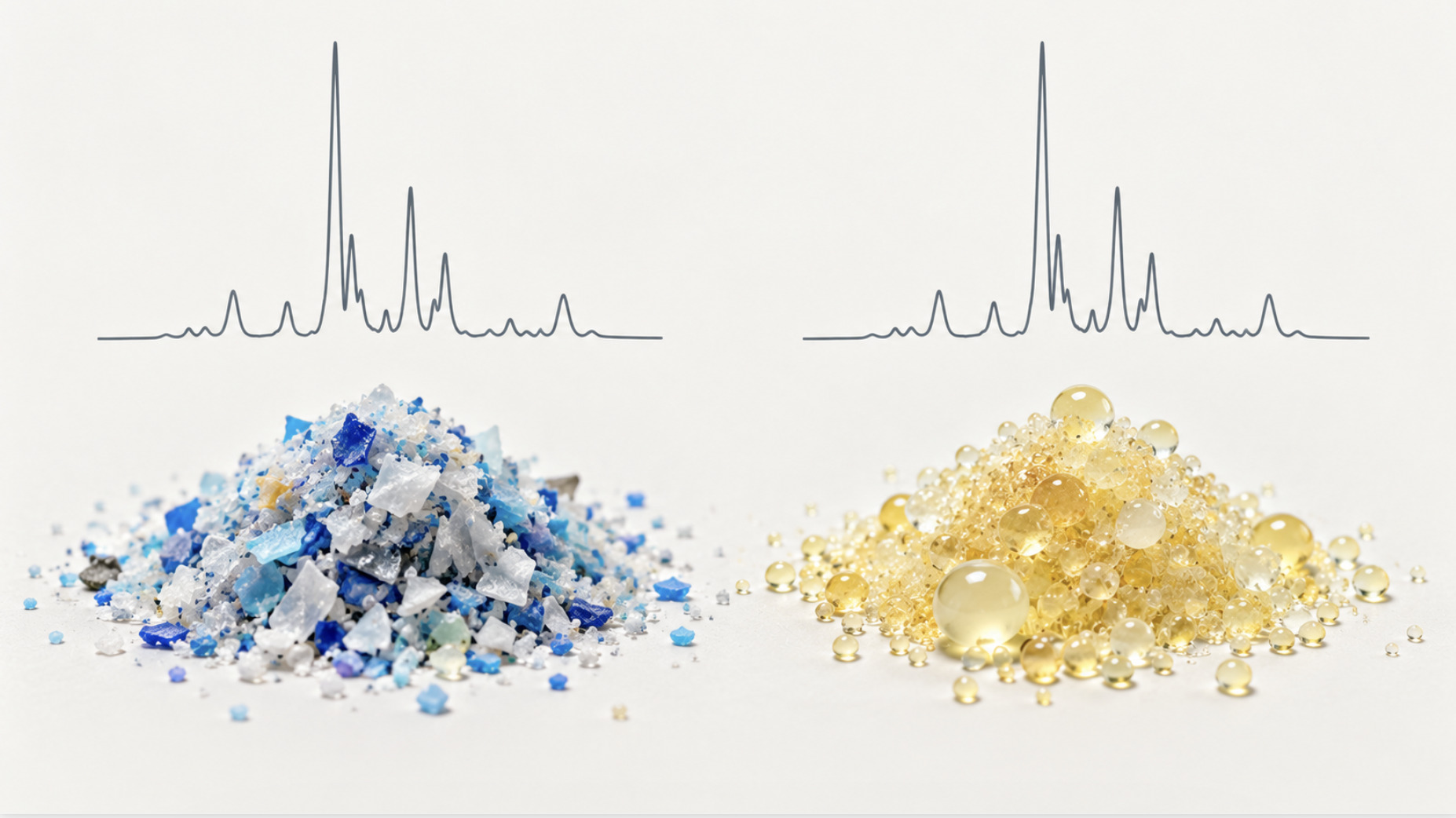
The central technical criticism concerns Py-GC/MS and fat. Polyethylene, the plastic most often reported in human tissue, is a simple chain of carbon and hydrogen. When it is heated, it breaks down into fragments that are chemically similar to those produced by heating fats. Unless fats are completely removed before analysis, they can generate signals that the instrument reads as polyethylene. Similar problems have been reported for polyvinyl chloride.
This matters most in fatty tissues. The brain is one of the fattiest organs in the body, so critics argue it is particularly vulnerable to false-positive signals. Dušan Materić, an environmental chemist at the Helmholtz Centre for Environmental Research in Germany, publicly argued that the reported brain concentrations could reflect fat rather than plastic. He suggested that rising obesity, rather than rising plastic, could explain an apparent increase over time. Cassandra Rauert, an environmental chemist at the University of Queensland, has described many reported tissue concentrations as unrealistic. She has also pointed out that current instruments cannot reliably detect nanoplastics in the way some studies imply.
In January 2026, reporting by The Guardian identified seven high-profile studies that had been formally challenged in scientific journals, including the brain and carotid plaque studies. It also cited an analysis that flagged 18 studies for not accounting for tissue that can generate signals mimicking common plastics. Other concerns included contamination from laboratory equipment and air, which is hard to avoid when the substance being measured is everywhere, and the absence of procedural blanks in some studies. Procedural blanks are samples processed in exactly the same way as tissue but containing no tissue, used to measure contamination.
The study authors have defended their work. Campen has said the field is young, that methods will improve, and that critics have not produced data showing the findings are wrong. Others have pointed out that independent methods, such as electron microscopy and infrared spectroscopy, identified plastic particles in some of the same samples. The particles are therefore not entirely an artefact, even if the quantities are uncertain.
The fair summary is that plastic particles almost certainly reach some human tissues, but the amounts reported by mass-based methods in fatty tissues are uncertain and may in some cases be substantially overstated. Reliable, standardised methods for human tissue, with proper contamination controls and fat removal, are still being developed.
How much plastic do people actually take in
The most widely repeated exposure figure, that people swallow about 5 grams of plastic a week, roughly the weight of a credit card, came from a 2019 analysis commissioned by WWF and carried out at the University of Newcastle in Australia. Later work found the estimate was far too high. Studies including a 2021 analysis in Environmental Science & Technology by Nur Hazimah Mohamed Nor and colleagues, which modelled intake from diet and air across a lifetime, estimated median adult intake in micrograms per week. That is more than a thousand times lower. A 2022 paper whose title asked whether humans eat one credit card a week concluded, after reviewing the calculations, that they do not.
Exposure estimates remain uncertain because measurements in food, water and air vary widely and depend heavily on methods. The direction of the correction, however, is clear. The credit-card figure substantially overstated intake.
Ingested particles are not necessarily absorbed. Most larger particles are thought to pass through the gut and be excreted. Smaller particles and nanoplastics are more likely to cross into tissues, but the fraction absorbed in humans is not well established.
What the health evidence shows so far
Evidence on health effects comes from several sources, which must be kept distinct.
Laboratory and animal studies have shown that microplastics and nanoplastics can cause inflammation, oxidative stress and changes to the gut lining and its microbes in cells and animals. Some studies have reported effects on reproduction and metabolism in rodents. These studies often use high doses, specific particle types and sizes, and short exposure periods that may not reflect typical human exposure. They show possible mechanisms, not established human outcomes.
Human observational studies have found associations between measured plastic and health outcomes, such as the carotid plaque study. These cannot establish causation and are affected by the measurement uncertainties above.
Chemical additives add a further layer. Plastics can contain or carry chemicals such as phthalates, bisphenols and flame retardants, some of which have well-studied health effects. Exposure to those chemicals comes from many sources besides microplastic particles, and separating the effect of particles from the effect of chemicals is difficult.
Regulatory assessments have so far been cautious. In 2019, the World Health Organization concluded that, on the limited evidence available, microplastics in drinking water did not appear to pose a health risk at the levels then reported. It noted, however, that data were insufficient and called for more research. The WHO has since repeated that the evidence on human health effects remains limited.
The distinction between hazard and risk is important here. Laboratory evidence suggests that microplastics can cause biological effects under some conditions, which is a hazard. Whether typical human exposure causes meaningful harm is a question of risk, and that question remains open. The current evidence neither demonstrates harm nor rules it out.
What regulators are doing
Regulation has focused mainly on reducing sources rather than setting health-based limits, because no agreed health-based threshold exists.
In the European Union, a restriction under the REACH chemicals regulation adopted in September 2023 phases out intentionally added microplastics in many products, beginning with loose glitter and microbeads in cosmetics and extending to other uses over several years. In the United States, the Microbead-Free Waters Act of 2015 banned plastic microbeads in rinse-off cosmetics.
California has taken the lead on measurement. Its State Water Resources Control Board adopted a definition of microplastics in drinking water in 2020. In 2022 it approved a policy requiring testing of some public water systems, the first such requirement in the world. The purpose was to gather data rather than to enforce a limit.
None of these measures sets a limit on microplastics in human tissue or food based on health effects. Such limits would require reliable measurement methods and dose-response evidence that do not yet exist.
Reading the next microplastics headline
New studies on microplastics in the body will continue to appear. A few questions help put them in context.
How was plastic measured? Mass-based results from fatty tissues using Py-GC/MS are the most disputed. Studies that confirm results with independent methods, and report blanks and fat-removal steps, are more credible.
Is the finding a detection or a quantity? Detecting plastic in a tissue is more robust than claiming a precise concentration.
Is the health link an association or a demonstrated effect? Observational studies in humans show associations. Animal and cell studies show possible mechanisms. Neither alone establishes that typical exposure causes disease in people.
What dose was used? Animal studies often use exposures far above what people typically encounter.
Is a dramatic comparison justified? Comparisons such as credit cards or spoonfuls should be checked against the underlying measurements, which are often far smaller or far less certain.
What can be said with reasonable confidence
Microplastics are widespread in the environment, and people are exposed through food, drink and air, with indoor air an important source. Plastic particles appear to reach some human tissues, but reliable measurement in the body is difficult, and some widely reported quantities may be substantially overstated. The most dramatic exposure figure, a credit card a week, has been revised downward by orders of magnitude. Associations with heart disease and dementia have been reported, but they come from observational studies with significant measurement uncertainties and cannot establish cause. Laboratory and animal studies show biological effects under some conditions, but their relevance to typical human exposure is not yet known.
The scientific debate is not a dispute about whether microplastics exist or whether they should be studied. It is a dispute about how to measure them accurately in human tissue, how much people actually carry, and whether that amount affects health. Answering those questions will depend on better methods, larger studies and careful separation of what has been detected from what has been demonstrated.