The Cashless Economy Has a Blackout Problem
By MHB Admin ·

The scene below is hypothetical, but it is based on what happens when the power fails.
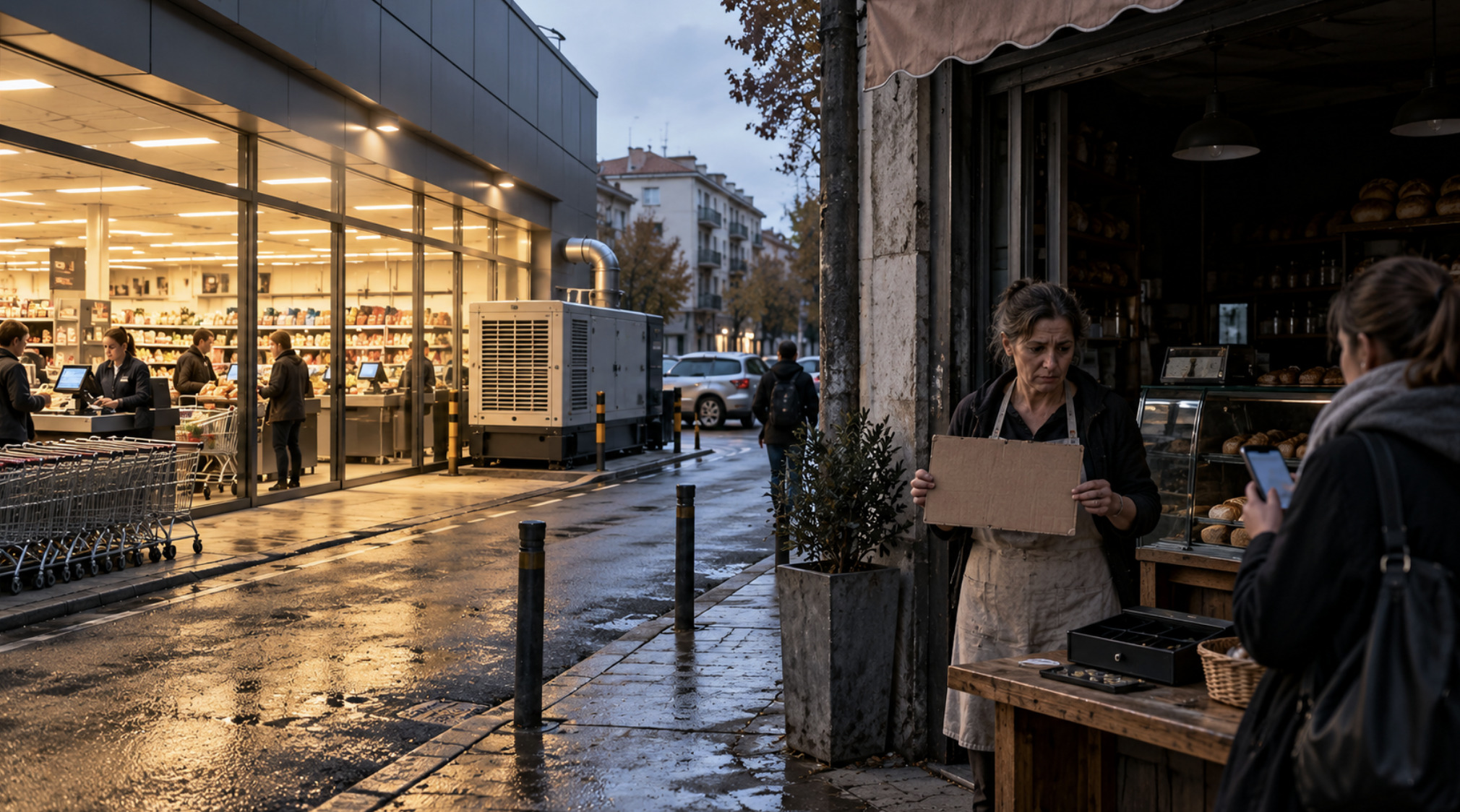
It’s a weekday lunchtime, and the lights in a mid-sized supermarket flicker and go out. The emergency lighting comes on. The refrigerators fall silent. At the checkouts, the card terminals show nothing at all. A queue forms, then stalls. A man with a full basket and no cash puts his shopping down and leaves. A woman counts the coins in her purse and decides which items she can afford. At the café next door, the owner writes “cash only” on a piece of cardboard, knowing most of her customers haven’t carried cash in years.
Nothing has been stolen, and no bank has failed. Every account balance in the country is exactly what it was five minutes ago. And yet, for anyone who relies on a card or a phone to pay, money has temporarily stopped working.
That’s the paradox at the heart of an increasingly cashless economy. Digital payments are fast, convenient and, in normal conditions, remarkably reliable. But they depend on a chain of systems most people never see, and every link in that chain needs electricity and connectivity.
Why governments are talking about blackouts now
The question is no longer theoretical. Over the past eighteen months, a series of official reports and campaigns has brought infrastructure fragility into public view.
In March 2025, the European Commission launched its Preparedness Union Strategy, encouraging people to be able to manage for at least 72 hours during a crisis. A month later, on 28 April 2025, the electricity systems of mainland Spain and Portugal collapsed in a matter of seconds, in one of Europe’s most serious blackouts in decades. In March 2026, the expert panel convened by ENTSO-E, the association of European transmission system operators, published its final report on what went wrong.
In September 2026, the EU cybersecurity agency ENISA published its latest Threat Landscape, warning that dependencies on third parties and supply chains expand the attack surface of digital infrastructure. On 13 October 2026, the International Monetary Fund’s Global Financial Stability Report described cyber threats as a growing systemic risk. And in late October, the UK Cabinet Office launched “Be Ready”, the first stage of a three-year campaign asking households to prepare for three days of disruption to essential services including power, phones and the internet.
None of these is a forecast of imminent collapse. Together, they reflect a shift in official thinking: resilience is now treated as an economic issue, not only an emergency-services issue.
What actually happens to a card payment
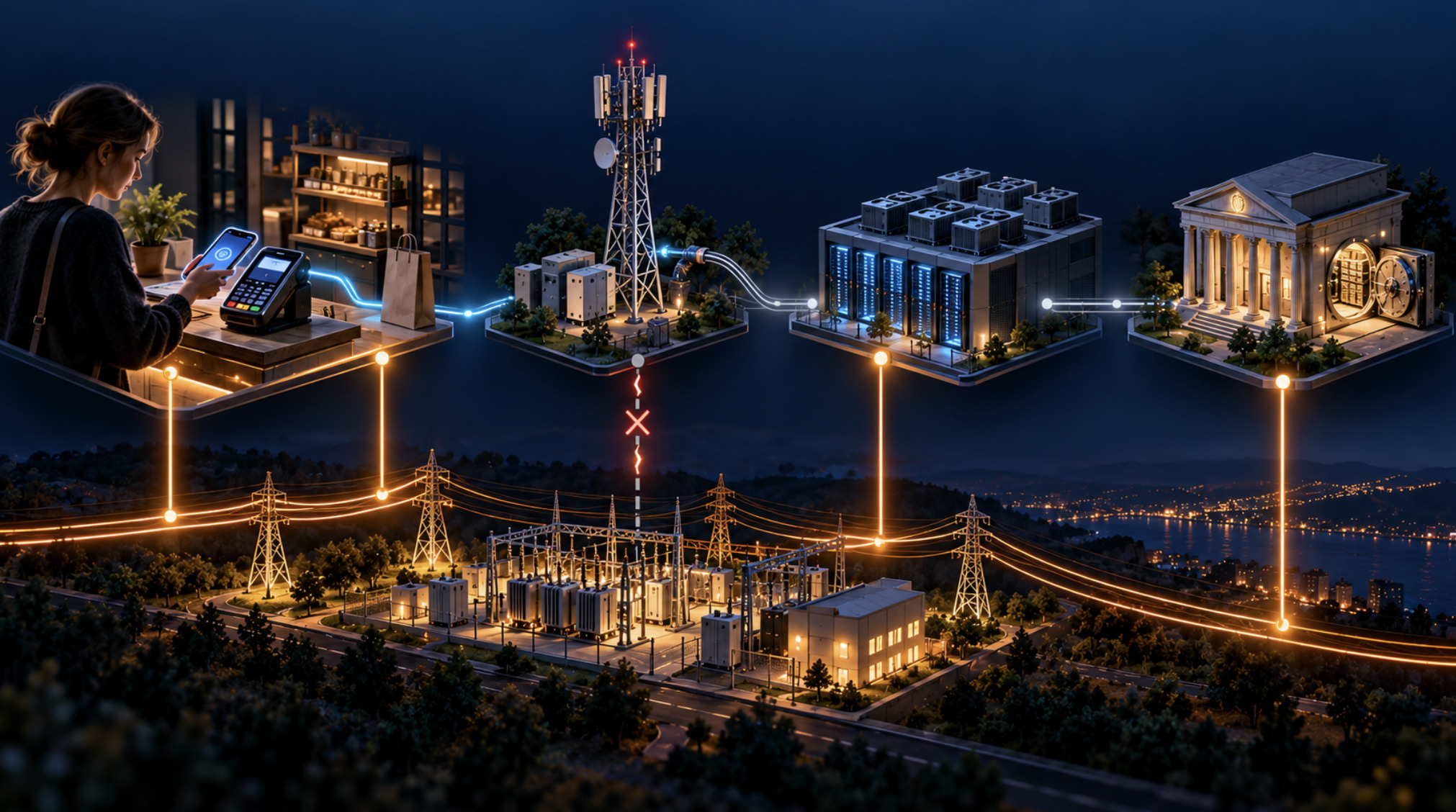
To understand why a blackout disrupts commerce, it helps to see what happens during an ordinary card payment. In a few seconds, several separate systems work in sequence:
The customer’s card or phone communicates with the payment terminal.
The terminal, powered by electricity, sends the transaction over a network connection.
The merchant’s payment provider receives the request and forwards it.
The card network routes it to the bank that issued the card.
The issuing bank checks the balance and fraud rules, then approves or declines.
The response travels back along the same chain to the terminal.
The money itself moves later, through settlement processes between banks. What happens at the till is an authorisation: a check that the payment can go ahead.
Each step needs power, and most need connectivity. A failure anywhere in the chain can stop the payment, even if every other part works perfectly.
Four different failures that look the same at the till
From the checkout, a declined or impossible payment looks the same whatever its cause. Underneath, very different things may be happening.
Type of failureWhat stops workingWhat still worksLocal electricity outageTerminals, tills, lightsBanks and card networks elsewhereInternet or mobile outageOnline authorisationTerminals with power, possibly offline modesPayment network failureAuthorisations through that networkOther networks, cashBanking system incidentSpecific bank servicesOther banks’ customers
A local power cut in one town leaves the national banking system untouched, while a failure at a payment processor can affect shops across a country that all have electricity. Not every service fails at the same time, and the type of failure determines who is affected.
Can card payments work without internet?
Partly, and with significant limits.
Many card systems have some capacity for offline transactions. A terminal can approve certain low-value payments without contacting the bank immediately, store them and send them for processing once the connection returns. The rules that govern this are set by card schemes, banks and payment providers, and they vary.
The limits matter:
The terminal still needs power. If it’s a mains-powered device without a battery, there’s no offline mode to speak of.
Offline approvals have limits. They often apply only to certain cards and amounts, and depend on how the terminal and the card are configured.
The risk shifts. A transaction approved offline isn’t checked against the customer’s real balance at that moment. If it later fails, the merchant may bear the loss.
Not every merchant uses it. Many businesses never configure offline payments, and many staff don’t know whether their terminal supports them.
Offline card capability is useful, but it isn’t a substitute for a working payment system during a long or widespread outage.
Can ATMs work during a power outage?
Generally not for long. ATMs need electricity to operate and a network connection to check the customer’s account with the bank. Some may have backup power to complete a transaction in progress, but not to keep dispensing cash through an extended outage. Even with power, an ATM that can’t reach the bank can’t safely authorise withdrawals.
This creates a frustrating contradiction. Cash is the most obvious fallback during an outage, but the most common way of getting cash also depends on the infrastructure that has failed. That’s why preparedness advice in several European countries encourages households to keep a modest amount of cash at home before a crisis, not to rely on withdrawing it during one.
What happens to bank balances during a blackout?
A bank balance doesn’t disappear because an app won’t load.
Account balances are records held in banks’ core systems, located in data centres that typically have extensive backup power and are often replicated across several sites. A blackout in a customer’s town, or an outage of the mobile network, doesn’t change those records. What disappears is the customer’s ability to access and use that balance at that moment.
That distinction matters, because the experience of a payment failure can feel like losing money. In practice:
the balance is still recorded at the bank;
pending transactions may be processed late once systems reconnect;
transfers may be delayed rather than cancelled;
duplicate or failed transactions can occur when people retry payments during disruption, and may need correcting afterwards.
A temporary disruption to access isn’t the same as a loss of funds, and it isn’t the same as a financial collapse.
The Iberian blackout: a real-world test
The April 2025 blackout offers the clearest recent example of how a modern economy behaves without electricity.
According to the ENTSO-E expert panel’s final report, published in March 2026, the collapse resulted from a combination of factors. They included weaknesses in voltage control and reactive power management, the behaviour of conventional and renewable generators, and protection settings that disconnected some plants earlier than regulatory thresholds allowed. Over a few seconds, the disconnections cascaded, and the Iberian system lost synchronism with the rest of the European grid. The panel issued 22 recommendations and noted that data gaps prevented it from fully explaining some disconnections. The investigation did not identify sabotage or a deliberate attack as the cause.
The economic effects were immediate and widely reported. Card terminals and ATMs stopped working, many shops could accept only cash or closed altogether, mobile networks became unreliable as backup power ran down, and transport systems were disrupted. Power was restored over the following hours, largely by the next morning.
What the episode demonstrated was not that digital payments are inherently fragile, but that they rest entirely on electricity. When the grid failed, most of the payment system didn’t fail by itself. It simply had nothing to run on.
Who is hit hardest
The same outage can be an inconvenience for one household and a crisis for another.
Low-income households and people without cash reserves. Those who live from one payment to the next, and who rarely hold cash, may be unable to buy food or fuel during a disruption. Households with savings, credit and stored supplies can wait.
Elderly people and people with disabilities. Many depend on electrically powered equipment, telephone-based support or digital services for daily life. Some face particular difficulties when ordinary routines break down.
Small independent businesses. A large supermarket chain may have backup generators, offline payment configurations and staff trained for emergencies. A small café or corner shop usually has none of these. When it cannot take payments, it loses the day’s income entirely, often with stock in fridges that cannot be kept cold.
Workers paid through digital platforms. Delivery riders, gig workers and others paid through apps may lose both their work and their access to earnings during an outage.
Rural communities. Areas with fewer bank branches, fewer cash machines and less redundant network coverage can lose services more completely and recover more slowly.
People who depend on electronic benefits. Benefits paid electronically become difficult to use if the recipient has no cash and payment systems are down.
In each case, the infrastructure failure is the same. What differs is the margin people have to absorb it.
Cash and digital payments: strengths and weaknesses
Neither system is resilient on its own.
Cash works without electricity or connectivity at the point of sale. It’s simple, immediate and accessible to people without bank accounts. But it can be lost or stolen, it’s difficult to obtain during an outage if ATMs are down, and many businesses have reduced their capacity to handle it.
Digital payments are fast, traceable and convenient, and in normal conditions extremely reliable. They allow payments at a distance and support entire business models. But they depend on power, connectivity and a chain of intermediaries, any of which can fail.
The resilient approach isn’t to choose one over the other, but to keep both functioning. That is why several central banks and governments in Europe have argued for continued access to cash alongside digital payments. It is also why work on payment systems increasingly considers offline capabilities, including proposals for offline functionality in a future digital euro.
Concentration: the hidden systemic risk
A recurring theme in recent official reports is concentration. Many financial institutions, payment providers and businesses rely on a small number of large technology and cloud providers. The IMF’s October 2026 report identified this reliance on a few critical technology and cloud providers, together with greater digitalisation and cheaper attack tools, including AI, as drivers of systemic cyber risk.
Concentration means that a problem at one provider can affect many institutions at once, even if each of them has followed good practice. In the context of a blackout, it means that the resilience of the whole system depends partly on the backup arrangements of a handful of companies that the public rarely hears about.
What the IMF is and isn’t saying
The IMF’s assessment is easy to misread. Its October 2026 report described cyber threats as a growing systemic risk and recommended stronger cyber resilience, oversight of critical third-party service providers and cross-border cooperation. It also noted that each of the main risks it identified might be manageable on its own, while warning that combinations could have broader systemic implications.
That is a description of vulnerability, not a prediction that a cyberattack will cause a financial crisis. Identifying weak points is how institutions decide where to invest in resilience. It doesn’t mean collapse is imminent.
How blackouts affect the wider economy
The economic effects of a large outage extend beyond the hours without power:
Business continuity: shops, factories and offices lose production and sales, and perishable stock may be lost.
Supply chains: logistics companies that can’t access their systems or refuel vehicles create knock-on delays.
Payment liquidity: households and small businesses without cash or savings face immediate difficulty paying for essentials.
Consumer confidence: visible disruption can affect spending and trust in services.
Public services: hospitals, transport and emergency services need backup arrangements, and some emergency spending follows.
Inequality: those with the fewest resources bear a disproportionate share of the cost.
How large these effects become depends on the duration and scope of the outage, and on how well businesses and public services prepared.
The deliberate blackout theory
During periods of geopolitical tension, theories circulate online claiming that governments, banks or powerful organisations might deliberately cause a major blackout to accelerate economic change, for example to push societies towards fully digital money or greater control over finances.
These claims deserve to be examined, not mocked, because they touch on legitimate concerns about transparency and accountability. Examining them means separating several different things.
Documented vulnerabilities. Grids, telecommunications and payment systems have real weaknesses, described openly in official reports.
Real attacks. Cyberattacks have caused power outages before, most notably in Ukraine in December 2015, when around 225,000 customers lost power, and again in 2016. Physical attacks on substations have also caused outages elsewhere.
Government emergency planning. Campaigns such as the UK’s Be Ready and the EU’s preparedness strategy are public, documented and similar to existing planning for floods, pandemics and storms.
Economic change after crises. Crises often accelerate existing trends, for example in digital payments during the pandemic. But change following a crisis is not evidence that the crisis was organised to produce it.
Claims of deliberate coordination. These go much further: they assert intent, planning and coordination by specific actors.
To substantiate such a claim, evidence would need to show identifiable actors, documented intent, technical evidence linking events to deliberate action, and findings that hold up under independent investigation. For the Iberian blackout, the official investigation reconstructed events in detail and attributed the collapse to grid behaviour and control factors, not to a deliberate act.
Theories like these gain traction partly because the systems involved are invisible and complex, and partly because trust in institutions is fragile. The best answer to them isn’t dismissal, but transparency: publishing investigations, explaining dependencies and making resilience measures visible to the public.
Why Europe is preparing
Europe’s renewed attention to blackouts reflects several pressures at once: geopolitical tension, documented cyber threats, extreme weather, the growing complexity of electricity systems, and the lessons of the Iberian collapse. Preparing doesn’t mean expecting disaster. It means accepting that modern economies have become dependent on systems that rarely fail, and that rare failures can still be very costly.
Resilience is an economic choice
The cashless economy isn’t broken. In normal conditions, it works remarkably well. But it was largely designed for normal conditions. Resilience means planning for the hours when the terminal goes dark: keeping cash available, configuring offline payment options sensibly, protecting small businesses and vulnerable households, and reducing dependence on single points of failure.
In the supermarket at the start of this article, nobody’s money had gone anywhere. What had gone was the infrastructure that let them use it. Making that infrastructure more resilient, and making sure the costs of failure don’t fall only on those least able to bear them, is now as much an economic question as a technical one.