The Civil Forfeiture System That Lets Police Seize Cash Without Charges
By MHB Admin ·
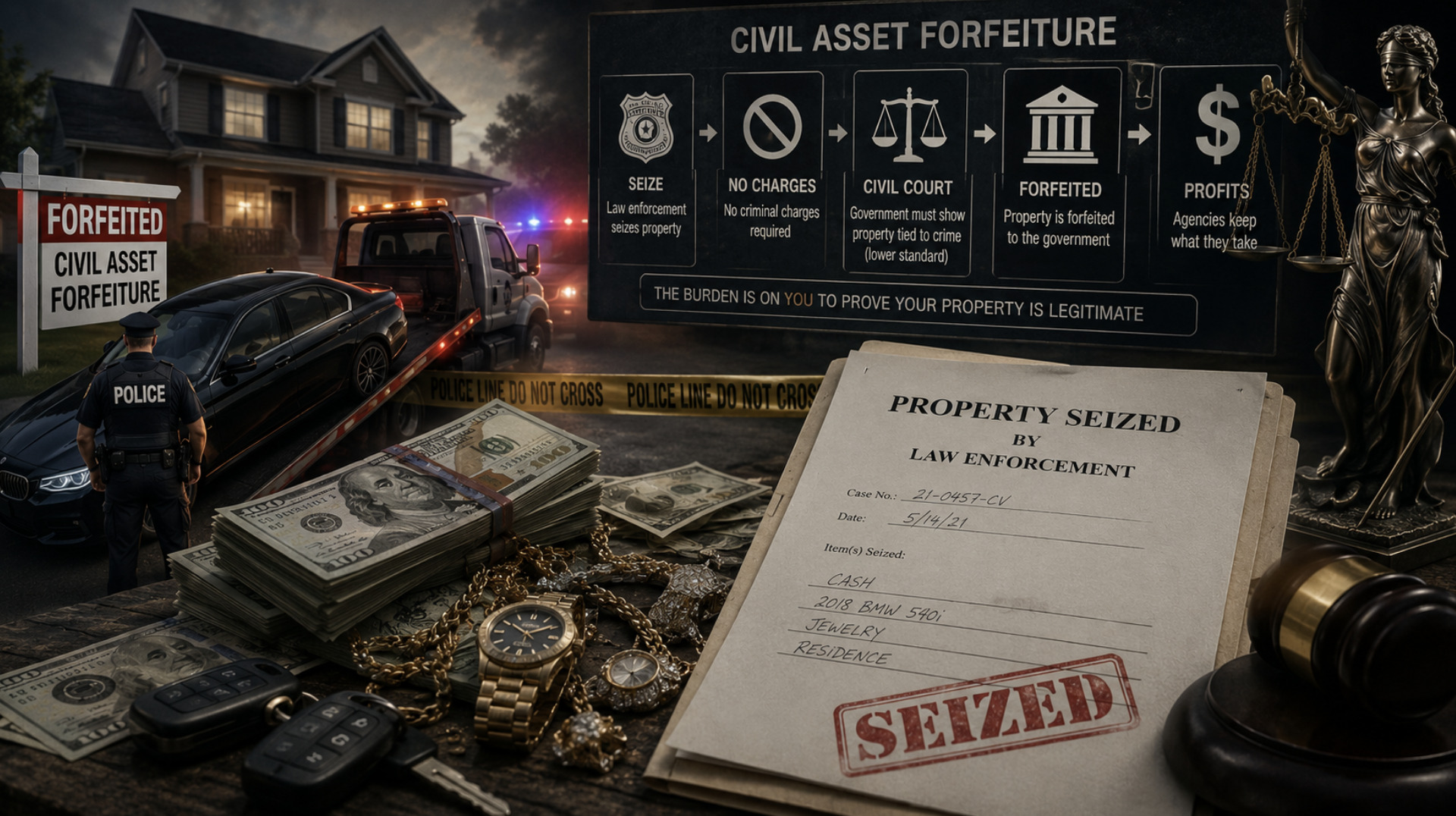
Most people assume that in a country built on the presumption of innocence, the government cannot take your property unless you have been convicted of a crime. Most people are wrong. Through a legal mechanism called civil asset forfeiture, law enforcement can seize cash, cars, and even homes from people who are never charged with anything, let alone convicted — and then keep what they take. It is one of the strangest and most quietly consequential practices in the American legal system, operating largely out of public view, and it inverts the basic protections most citizens believe they have. Understanding how it works reveals a gap between the justice system people imagine and the one that actually exists.
Property on trial, not people
The peculiarity that makes civil forfeiture possible is a legal fiction so odd it sounds invented: the case is brought against the property itself, not the person. This is why forfeiture cases carry bizarre names in which the government sues an object — a sum of money, a vehicle — as though the thing were the defendant. Because the action is technically against the property rather than a person, it is treated as a civil matter, not a criminal one, and that classification is the entire engine of the system.
The reclassification matters enormously, because civil and criminal cases operate under completely different rules. In a criminal case, the state must prove guilt beyond a reasonable doubt, and the accused enjoys the full array of constitutional protections. In a civil forfeiture case, none of that applies in the same way, because on paper no person is being accused of a crime — only a piece of property is being claimed. The owner, whose cash or car is being taken, is relegated to the position of a third party trying to intervene on behalf of their own belongings. It is a sleight of hand that removes the protections of criminal law from a process that, to the person losing everything, feels exactly like punishment.
The burden turned upside down
The most troubling consequence flows directly from that civil classification: the burden of proof is reversed. In the criminal justice system, the government must prove you did something wrong. In civil forfeiture, because the property is the defendant, it can fall to the owner to prove their property was not connected to a crime in order to get it back. The presumption of innocence, the bedrock protection of criminal law, simply does not operate the same way — the property is effectively presumed guilty, and the owner must affirmatively establish otherwise.
This inversion has brutal practical effects. Someone can have a large amount of cash seized at a traffic stop or an airport on the mere suspicion that it is tied to illegal activity, without ever being charged, and then face the task of proving a negative to recover their own money. That is difficult, slow, and expensive, and it collides with a second cruel feature of the system: fighting a forfeiture often costs more in legal fees than the seized property is worth. Faced with spending thousands to recover a smaller sum, many people simply walk away, letting the state keep what it took not because the seizure was justified but because contesting it is uneconomical. The system's design quietly ensures that a great deal of questionable seizure is never challenged at all. It is a structural silencing of the sort we also traced in the plea bargain machine that quietly replaced the American trial, where the process itself pressures people out of asserting their rights.
The incentive that drives it
To understand why civil forfeiture is used as heavily as it is, you have to look at where the seized property goes, because that is where the real force of the system lies. In many places, the law enforcement agencies that carry out the seizures get to keep the proceeds, funnelling the cash and the value of forfeited property directly into their own budgets. This creates a direct financial incentive to seize: the more an agency takes, the more its own funding grows.
That incentive is the heart of the critique, and it should trouble anyone regardless of politics. A justice system is supposed to be motivated by justice, not by revenue, yet civil forfeiture ties an agency's material interests to how much property it can take from citizens. It invites a dynamic in which seizures are driven partly by the budgetary benefit to the seizing agency rather than purely by the merits of each case — a conflict of interest baked into the structure itself. When those who decide whether to take your property also profit from taking it, the neutrality the system depends on is compromised at the root. This is the pattern that recurs across so much of what gets overlooked: an incentive quietly pointing an institution away from its stated purpose, much as we found in tracing how FOIA became slower, weaker and less effective.
Who pays and why it persists
Like many quiet injustices, civil forfeiture falls hardest on those least able to fight it. The people most affected are frequently those without the resources to mount a costly legal challenge, and disproportionately those carrying cash rather than moving money through banks — a group that skews toward the poor, the unbanked, and communities already under heavier policing. For someone of means, an unjust seizure is an outrage to be litigated; for someone living close to the edge, it can be a catastrophe they have no practical way to contest. The system's costs and reversed burdens ensure that the people with the weakest ability to fight back are the ones most likely to simply lose.
That distribution of harm is also why the practice endures with so little public outcry. Its victims are often those with the least political voice, its mechanics are buried in civil procedure most people never encounter, and its beneficiaries are the very agencies with an interest in keeping it. The result is a practice that contradicts the presumption of innocence at the foundation of American justice, yet operates steadily in the background, taking property from people who are never accused of a crime. Bringing it into view is the first step toward reckoning with it — because a system that can take your belongings without charging you, keep the proceeds, and make you prove your own innocence to get them back, is precisely the kind of overlooked machinery that runs best when no one is looking.
Frequently asked questions
Can police take your property without charging you with a crime? Yes, through civil asset forfeiture. Because the legal case is technically brought against the property itself rather than a person, it is treated as a civil matter, allowing law enforcement to seize cash, vehicles or homes on suspicion of a connection to crime without ever charging — let alone convicting — the owner.
Why is the burden of proof reversed in civil forfeiture? Because the property, not the person, is the defendant, the case is civil rather than criminal, so the criminal presumption of innocence does not apply the same way. It can fall to the owner to prove their property was not connected to a crime in order to recover it, rather than the government proving that it was.
Why do agencies use civil forfeiture so heavily? In many jurisdictions the agencies that seize property get to keep the proceeds, adding the cash and value directly to their own budgets. This creates a direct financial incentive to seize, tying an agency's funding to how much it takes and raising a structural conflict between pursuing justice and pursuing revenue.