The Junk Forensics That Put Innocent People Behind Bars
By MHB Admin ·
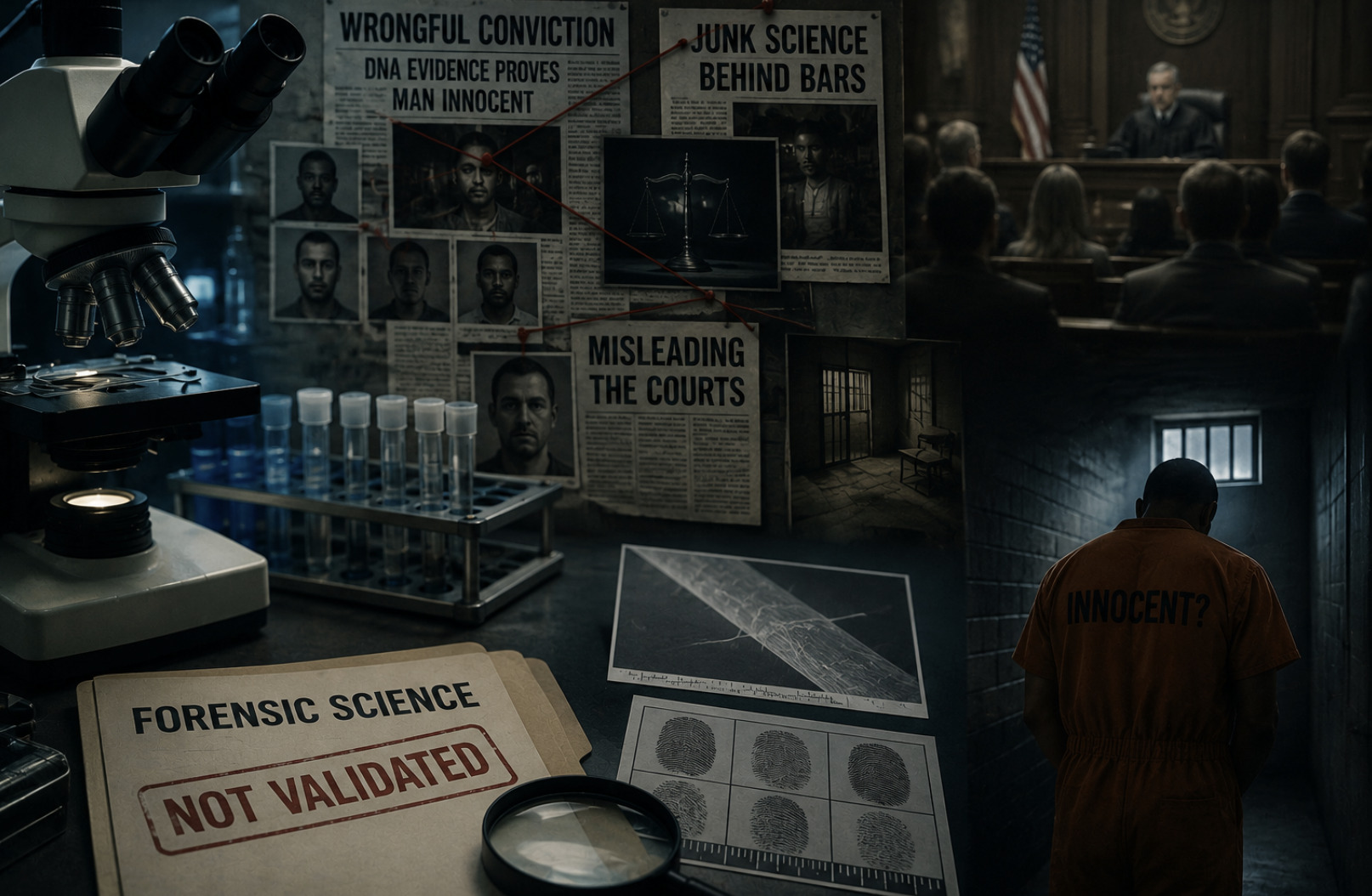
On television, forensic science is infallible. A technician glances at a hair under a microscope, matches it to a suspect, and the case is closed. The jury nods; the audience is satisfied; justice, apparently, is a matter of laboratory certainty. The reality is far darker and far less settled. A significant portion of what has been presented in American courtrooms as "forensic science" was never scientifically validated at all — and in case after case, it has helped send innocent people to prison. This is not a story about a few bad analysts. It is a story about entire disciplines that acquired the authority of science without ever earning it, and about a justice system that trusted them anyway.
The authority of the lab coat
Forensic evidence carries a weight in the courtroom that few other kinds of testimony can match. When an expert takes the stand and declares that two samples "match," jurors hear the voice of objective science, neutral and above the messy human business of eyewitnesses and confessions. That perceived certainty is enormously persuasive, and it is precisely what makes flawed forensics so dangerous. A shaky identification from a frightened witness invites doubt; the same claim dressed in the language of science does not.
The trouble is that much of this authority was borrowed rather than earned. Several forensic techniques were developed and adopted by the legal system long before anyone tested whether they actually worked — whether their conclusions were reliable, repeatable, or supported by evidence. They entered courtrooms, were accepted by judges, and hardened into precedent, gathering the prestige of science while skipping the part where science demands proof. By the time anyone asked the hard questions, thousands of convictions already rested on them.
Disciplines that could not survive scrutiny
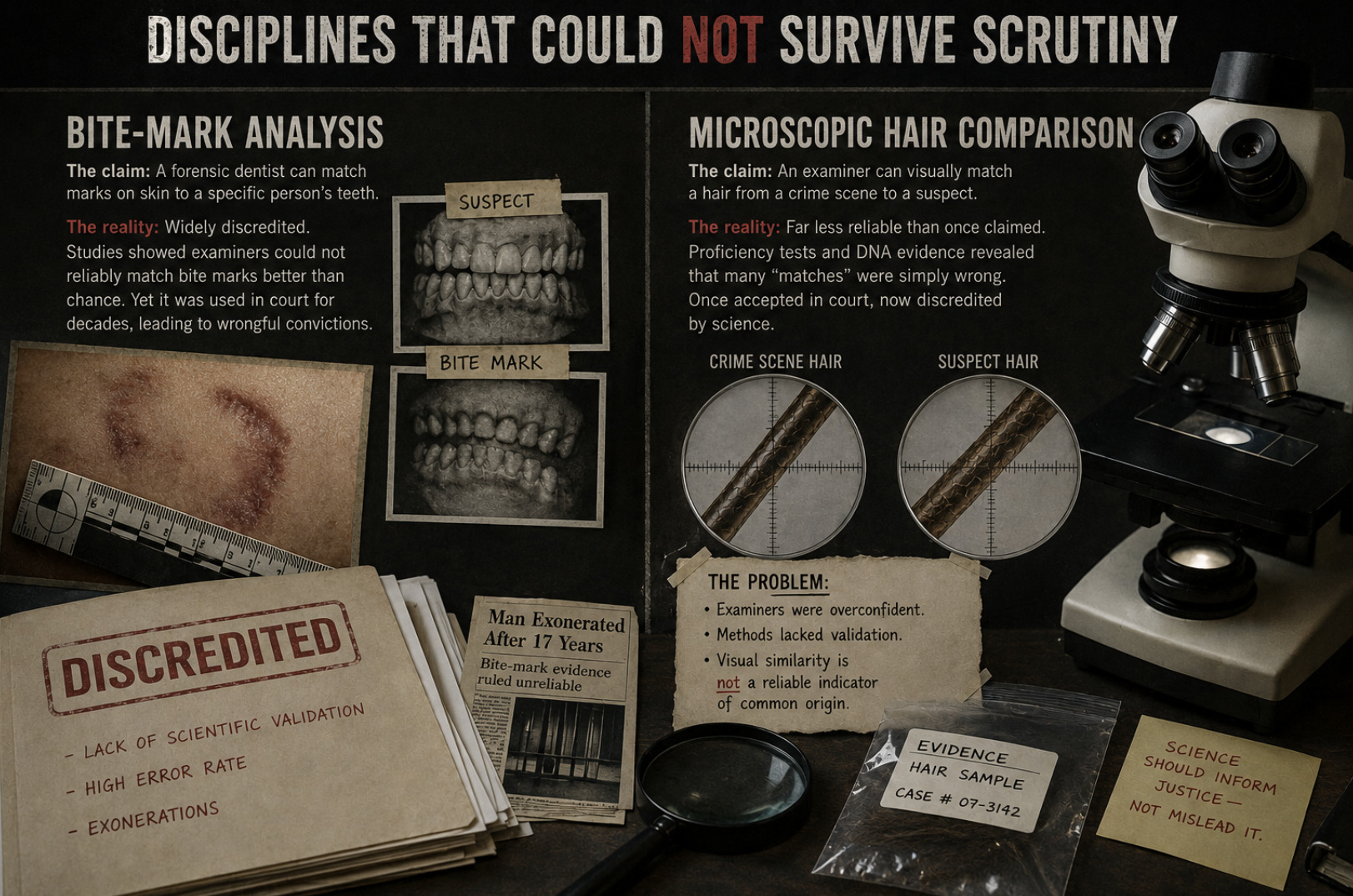
When rigorous review finally came, some of these techniques did not survive it. Bite-mark analysis is the starkest example: the claim that a forensic dentist can match marks on a victim's skin to a specific person's teeth has been widely discredited, yet it was used for years to help convict people, some of whom were later exonerated. Microscopic hair comparison — the idea that an examiner can visually match a hair from a crime scene to a suspect — was likewise found to be far less reliable than juries were led to believe, after DNA testing revealed how often such "matches" were simply wrong.
Other disciplines fared little better under examination. Bloodstain-pattern analysis, certain assumptions long used to identify arson, and aspects of other pattern-matching fields have all faced serious questions about whether their conclusions rest on validated methods or on the confident intuition of practitioners. Landmark reviews — a 2009 report by the National Academy of Sciences and a 2016 report by the President's Council of Advisors on Science and Technology among them — reached a sobering conclusion: for a number of forensic techniques treated as reliable in court, the scientific foundation was thin, overstated, or absent. The word "science" had been doing work the evidence could not.
How the errors reach the jury
Even where a technique has some validity, the way its results are described can turn a modest finding into a false certainty. An examiner might reasonably say that two samples are consistent with each other; what juries too often hear instead is that they match, uniquely and definitively. The leap from "cannot be excluded" to "is the source" is enormous, and it is a leap that overstated testimony has made again and again. Language that a scientist would hedge becomes, on the stand, a declaration of guilt.
Compounding this is the problem of bias. Forensic analysts frequently work closely with police and prosecutors and are not always shielded from knowing what result the investigation is hoping for, which can subtly shape an inherently subjective judgment. A comparison that depends on a human deciding whether two patterns "look alike" is exactly the kind of task where expectation can quietly steer the answer. None of this requires bad faith; ordinary cognitive bias is enough to tilt a close call in the direction everyone in the room already believes.
What DNA revealed
The clearest proof that something was wrong came from the one forensic method built on genuine science: DNA analysis. As DNA testing matured, it allowed old cases to be reexamined, and the results were damning. In a substantial share of the wrongful convictions later overturned by DNA evidence, flawed or overstated forensic testimony had helped put the innocent person away in the first place. The reliable science, in other words, kept exposing the unreliable science that had been masquerading as its equal.
This is what makes the phrase "junk forensics" more than rhetoric. These were not obscure techniques used in a handful of cases; they were mainstream tools, accepted in courtrooms across the country, that demonstrably contributed to convicting people who had done nothing. Each exoneration is a person who lost years, sometimes decades, to a method that sounded like science and was not — and each one raises the unanswerable question of how many others, without the luck of preserved DNA to test, remain in prison on the same kind of evidence.
A quiet injustice among many
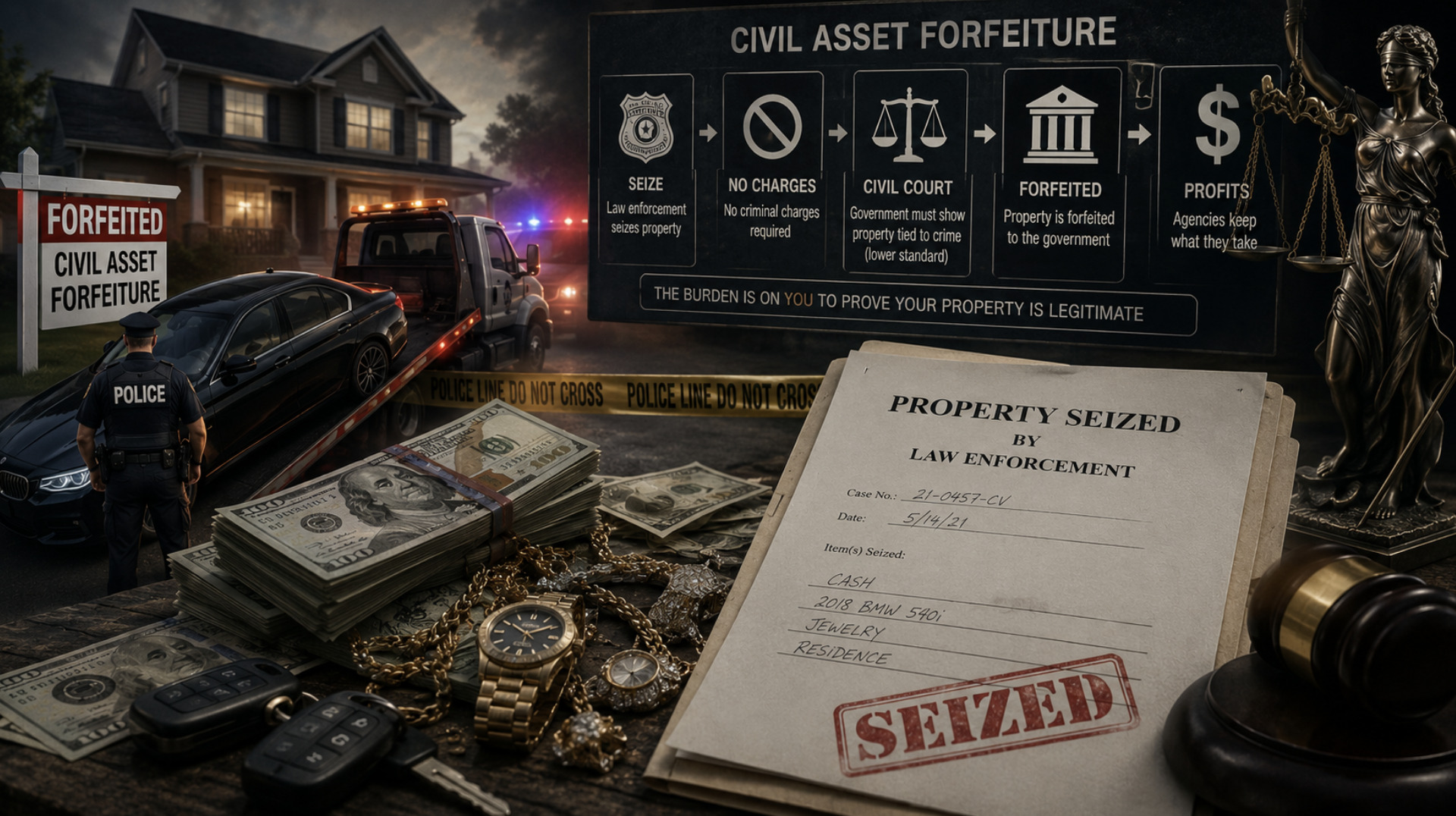
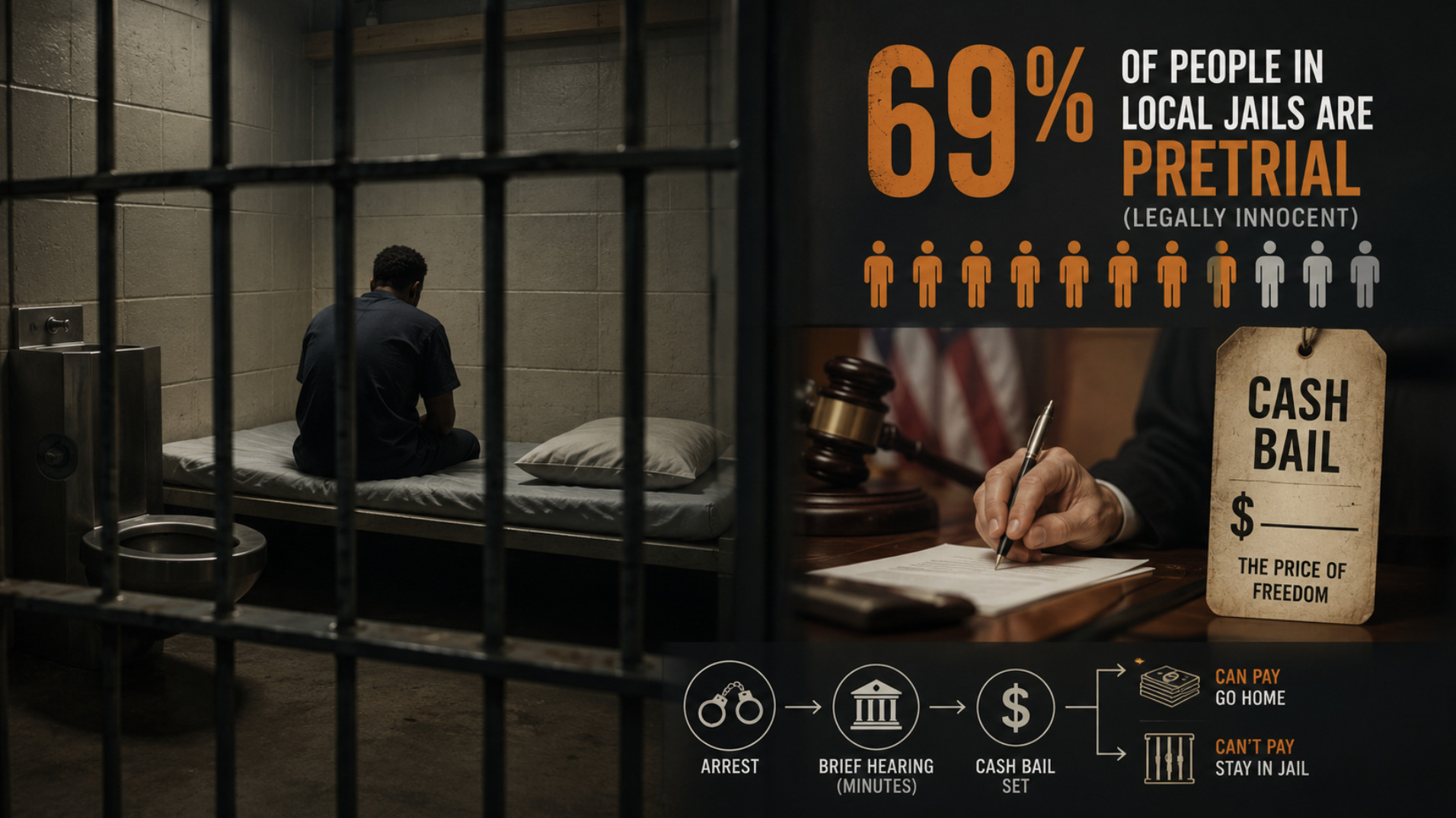
The problem of flawed forensics belongs to a larger pattern in the justice system, one this blog returns to often: the quiet mechanisms that produce injustice without spectacle. It sits alongside a bail system that jails people for being poor and a plea-bargain machine that extracts guilty pleas from the innocent, explored in the plea bargain machine that quietly replaced the American trial and the cash bail system that puts a price on freedom before trial. Like the machinery of civil forfeiture, junk forensics does its damage in the ordinary, unglamorous run of cases that never make the news.
There has been real progress — some techniques have been curtailed, standards have tightened, and courts have grown warier — but validated science is still not universally required before a forensic claim can help decide a person's freedom. The deeper lesson is about the danger of borrowed authority. When a method is allowed to wear the costume of science without submitting to its discipline, the result is not neutrality but a particularly persuasive kind of error, one juries are least equipped to doubt. The remedy is not to abandon forensic science but to insist that it actually be science — tested, validated, honestly described — before a life is staked on what it claims to see.