The Cash Bail System That Puts a Price on Freedom Before Trial
By MHB Admin ·
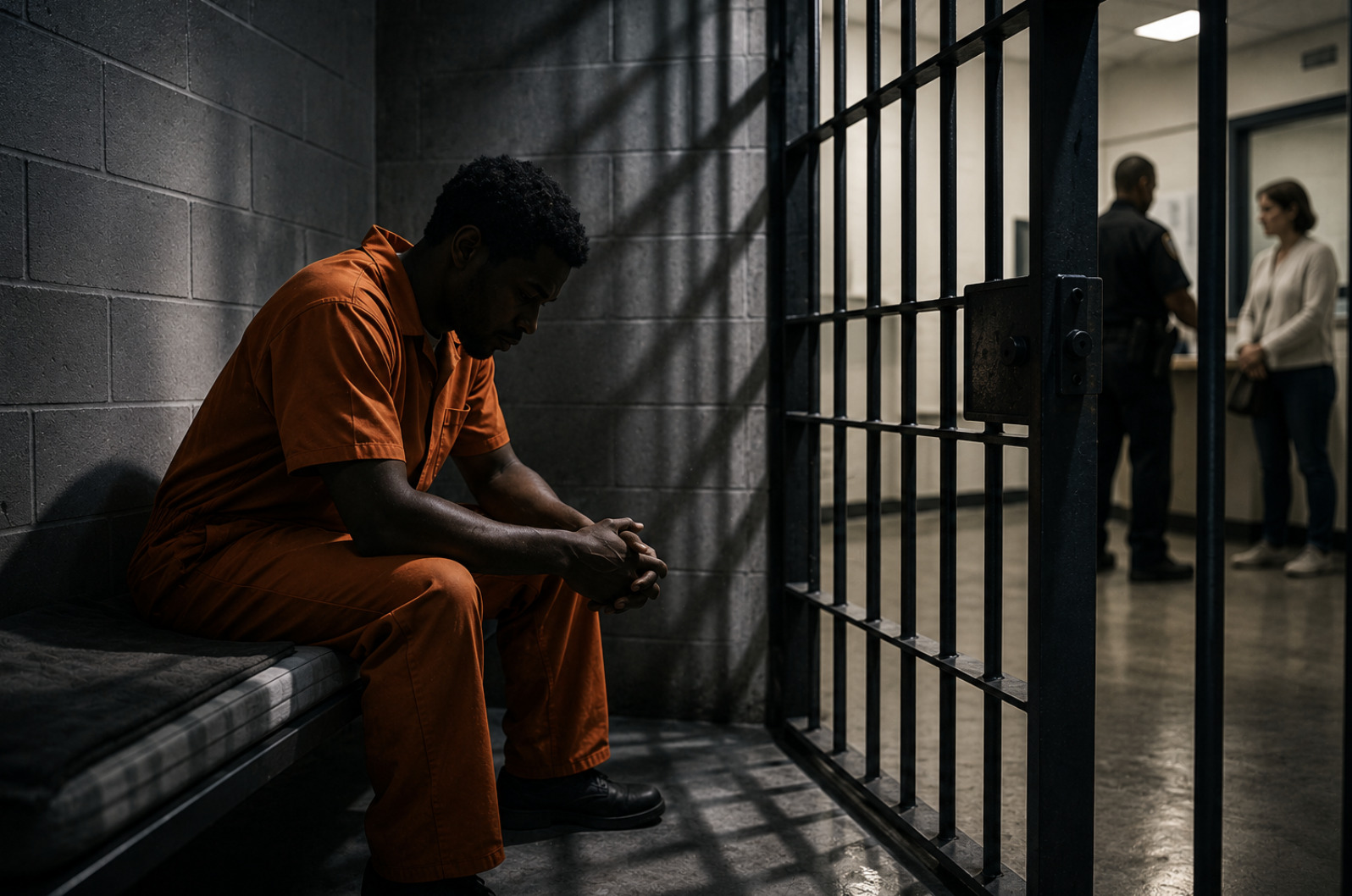
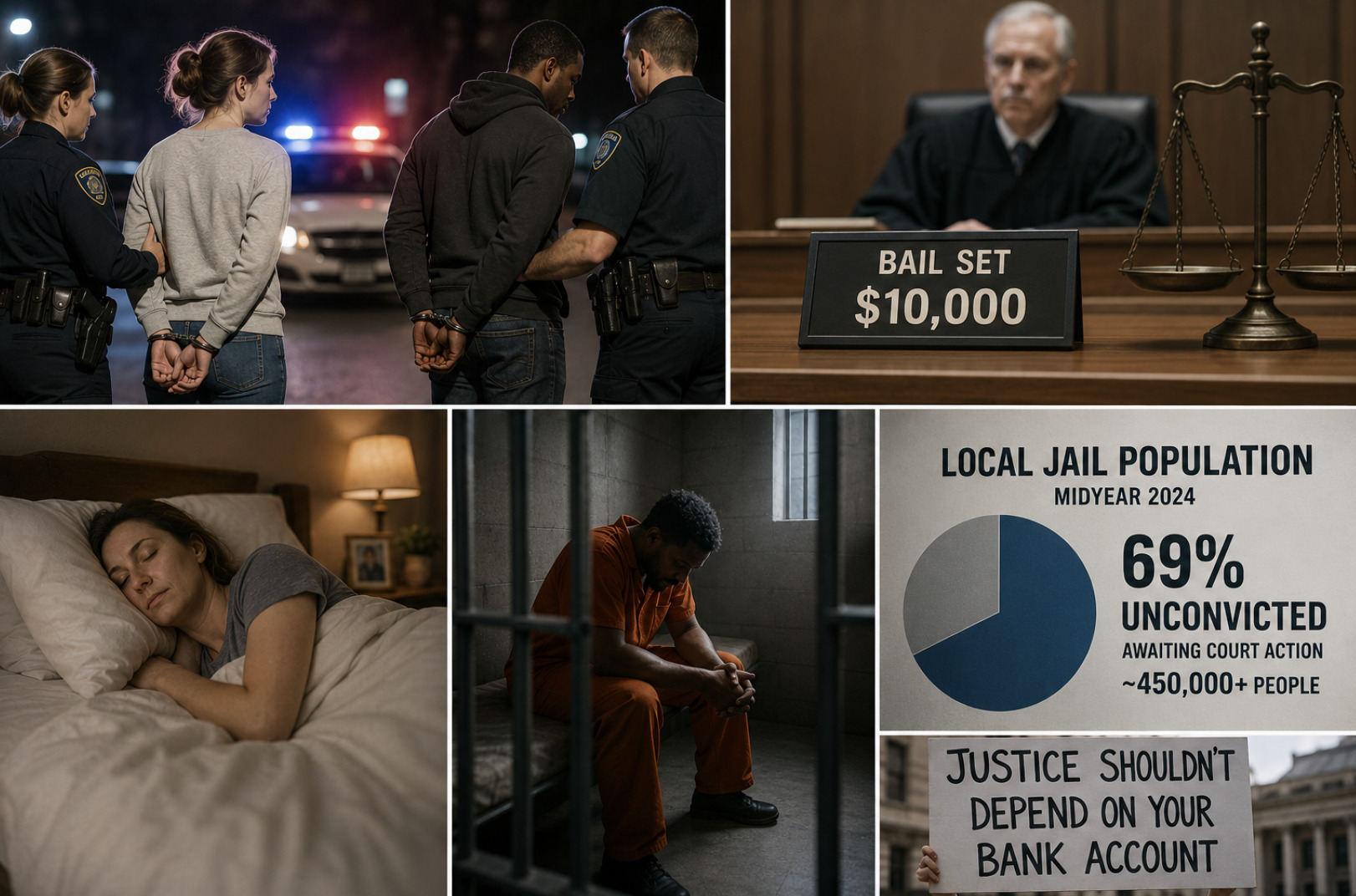
Two people are arrested on the same charge, in the same county, on the same night. A judge sets the same bail for both. One writes a check and sleeps in her own bed until trial. The other sits in a cell for weeks or months — not because a court found him more dangerous or more likely to flee, but because he could not produce the money. Nothing about the case has been decided. The only fact established so far is which of them has cash.
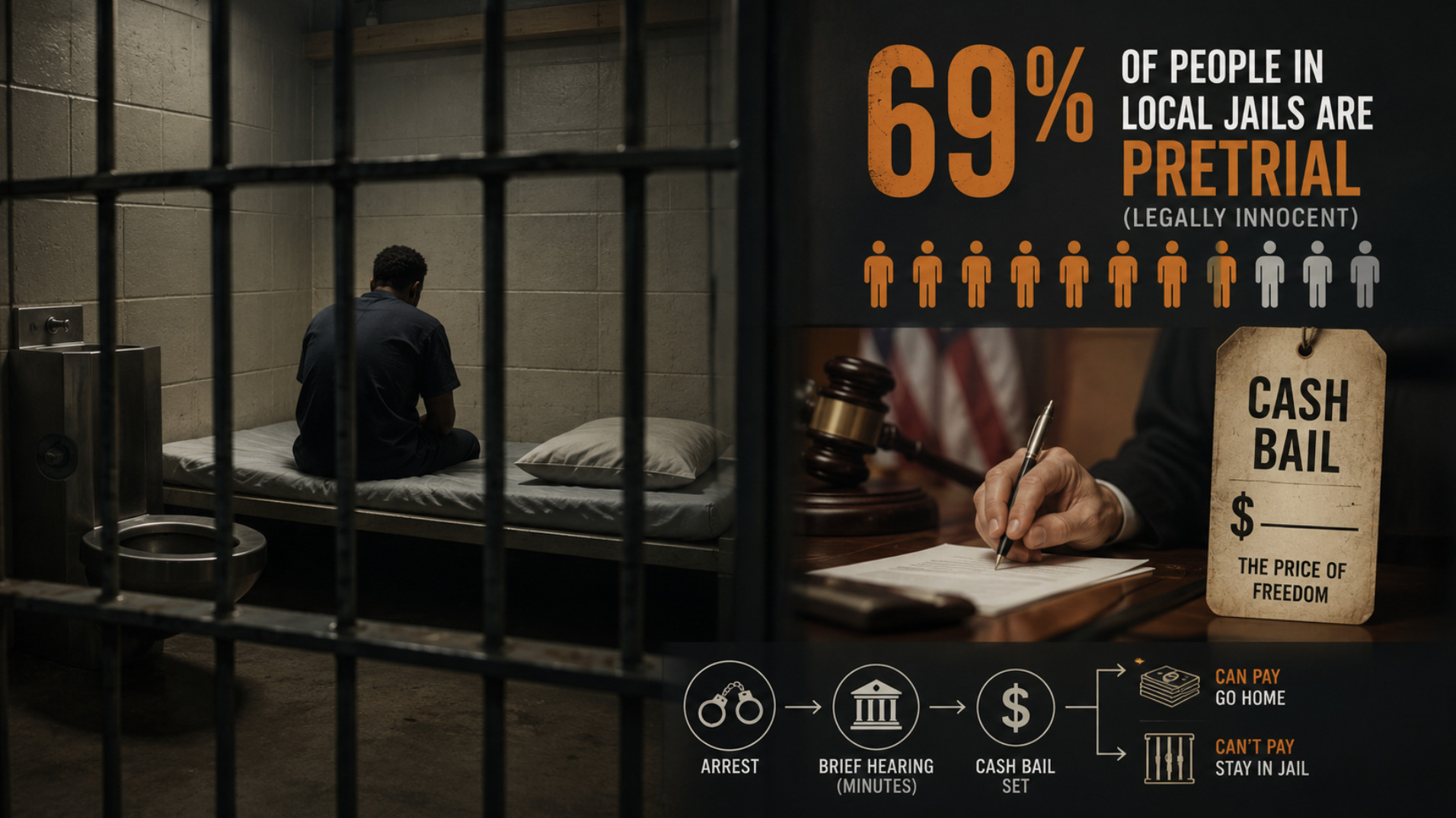
That is the quiet logic of cash bail, and it operates at enormous scale. According to the Bureau of Justice Statistics, about 69 percent of the roughly 650,000 people held in local jails at midyear 2024 — more than 450,000 people — were unconvicted, awaiting court action on their charges. The presumption of innocence is the stated rule of American criminal law. For most people in an American jail on any given day, it is a technicality.
What Bail Was Supposed to Do
The theory behind money bail is old and, on its face, reasonable. A defendant deposits something of value with the court as a guarantee of appearance; show up for trial and the money comes back, skip town and it is forfeited. Bail was designed as an incentive, not a punishment — a way to release people while keeping them tethered to the process.
The practice has drifted far from the theory. In most American courtrooms, bail is set in hearings that last minutes, often using schedules that attach dollar amounts to charges rather than to any individual assessment of risk. The number that comes out of that hearing does not measure whether a person is dangerous. It measures whether they are liquid.
The result is a two-track system. Defendants with savings, home equity, or families who can raise money purchase their release regardless of what they are accused of. Defendants without those resources stay in jail regardless of how minor the charge or how weak the case. Money functions as a proxy for trustworthiness, and it is a proxy that tracks wealth almost perfectly and risk hardly at all.
Who Actually Sits in Jail Before Trial
The people detained because they cannot pay are, unsurprisingly, poor. The Prison Policy Initiative's analysis Detaining the Poor found that people in jail who could not make bail had a median annual income of roughly $15,000 (in 2015 dollars) before their arrest — and that the median felony bail amount, around $10,000, represented about eight months of income for the typical detained defendant. For a large share of arrestees, a bail figure a judge considers routine is functionally a detention order.
The burden is not distributed evenly. The U.S. Commission on Civil Rights reviewed the research in 2022 and found persistent racial disparities: Black and Latino defendants tend to receive higher bail amounts than white defendants facing comparable charges and are more likely to be detained because they cannot pay. Because bail is set quickly, with little information, the process leaves ample room for the assumptions and shortcuts that produce those gaps.
What pretrial detention does to a life is well documented and fast. Jobs are lost within days. Housing follows. Children are displaced. And the detention itself becomes leverage in the case: a person sitting in jail can end the ordeal immediately by pleading guilty, often to time served. Studies reviewed by the Civil Rights Commission consistently find that detained defendants plead guilty more often, are convicted more often, and receive harsher sentences than similar defendants who were released. The bail decision — made in minutes, before any evidence is tested — quietly shapes the outcome of the case more than the trial most defendants never have.
The Ten Percent Machine Behind Every Bond
Where the state sets a price on liberty, a market forms to finance it. The American commercial bail bond industry — a business model that exists at scale almost nowhere else in the world — fronts the bond in exchange for a nonrefundable premium, typically 10 percent of the bail amount. A family that scrapes together $1,000 to bail out a relative on a $10,000 bond never sees that money again, even if every charge is dropped the next morning. Innocence is not a refundable condition.
Research by the ACLU and Color of Change estimated that the industry, backed by a small cluster of insurance corporations, collects on the order of $2 billion a year — much of it from families who could not afford the premium outright and signed installment contracts, sometimes secured by cars, homes, or wages.
The industry's stated justification is that it assumes the risk: if the defendant absconds, the bondsman pays the full bail. In practice, that risk is largely theoretical. The Prison Policy Initiative's report All Profit, No Risk catalogs the mechanisms — grace periods, remission rules, discretionary waivers, and simple non-enforcement — that let bond companies avoid paying forfeitures when clients fail to appear. Local investigations cited in the report found bond agents and their insurers owed Harris County, Texas an estimated $26 million in unpaid forfeitures, and more than $35 million to Dallas County, accumulated over decades. Counties rarely have the resources to chase well-lawyered surety companies for the money, so the debts sit. The premium revenue, meanwhile, is collected up front, every time.
It is a familiar architecture in American criminal justice: a fee-based machine that extracts revenue from the people least able to pay it, while the risk it claims to absorb is quietly shifted back onto the public. The same pattern runs through civil asset forfeiture, where property is taken from people never convicted of anything — and, on the civil side of the economy, through wage theft that rarely gets called crime at all. Who pays, and who is called a criminal, depends less on harm done than on where you sit.
What Illinois Learned by Abolishing Cash Bail
For decades, defenders of money bail warned that removing it would empty the jails onto the streets and send crime soaring. In September 2023, Illinois became the first state to eliminate cash bail entirely, under the Pretrial Fairness Act — replacing money with hearings in which judges decide, on the record, whether a person should be detained because they are dangerous or likely to flee, not whether they can pay.
The early evidence, tracked by Loyola University Chicago's Center for Criminal Justice, does not match the warnings. In the first year, jail populations fell — by roughly 14 percent in Cook County and by around a quarter in some rural counties studied — while statewide violent and property crime declined rather than rose. Failure-to-appear rates, the metric bail supposedly protects, stayed essentially flat. Researchers caution that these are early results, that effects vary by county, and that some analyses found the reform did less than hoped to narrow racial disparities in who remains detained. But the core prediction of the bail lobby — that cash was the only thing standing between order and chaos — has so far simply not materialized.
Illinois's experience clarifies what cash bail was actually doing. It was not sorting the dangerous from the safe; judges can do that directly, in an open hearing, without a price tag. It was sorting the solvent from the broke.
Why a Failed System Persists
If money bail fails on its own terms, its durability needs explaining, and the explanation is unglamorous: the system works well for everyone with power inside it. Judges facing re-election can set high bail as cheap insurance against the rare released defendant who reoffends — the detained innocent generate no headlines. Prosecutors benefit from the plea leverage detention creates. The bond industry and its insurers, a concentrated and politically active lobby, have fought reform efforts in state after state, because every bond written is nearly pure margin. And counties, whatever forfeitures they fail to collect, have built budgets and jail capacity around the flow.
The costs, meanwhile, land on people with the least political voice: the arrested poor, disproportionately Black and Latino, whose lost jobs, lost homes, and coerced pleas are diffuse, private, and easy not to count.
What Comes After the Price Tag
None of this requires pretending pretrial risk is imaginary. Some people should be detained before trial, and a system that says so honestly — with evidence, counsel, and a judge's reasons on the record — is more defensible than one that hides the decision inside a dollar figure and lets a bondsman's fee schedule determine who goes home. That is the direction Illinois has taken, and that jurisdictions from New Jersey to Washington, D.C. have moved toward in different forms for years.
The deeper question cash bail poses is about what the presumption of innocence is worth. As long as freedom before trial carries a price, that presumption is means-tested — fully available to those who can pay, and a legal fiction for those who cannot. A justice system that jails people for poverty while calling it flight risk has not solved the problem of pretrial justice. It has priced it.