Collective Memory: Why Societies Remember Some Things and Forget Others
By MHB Admin ·
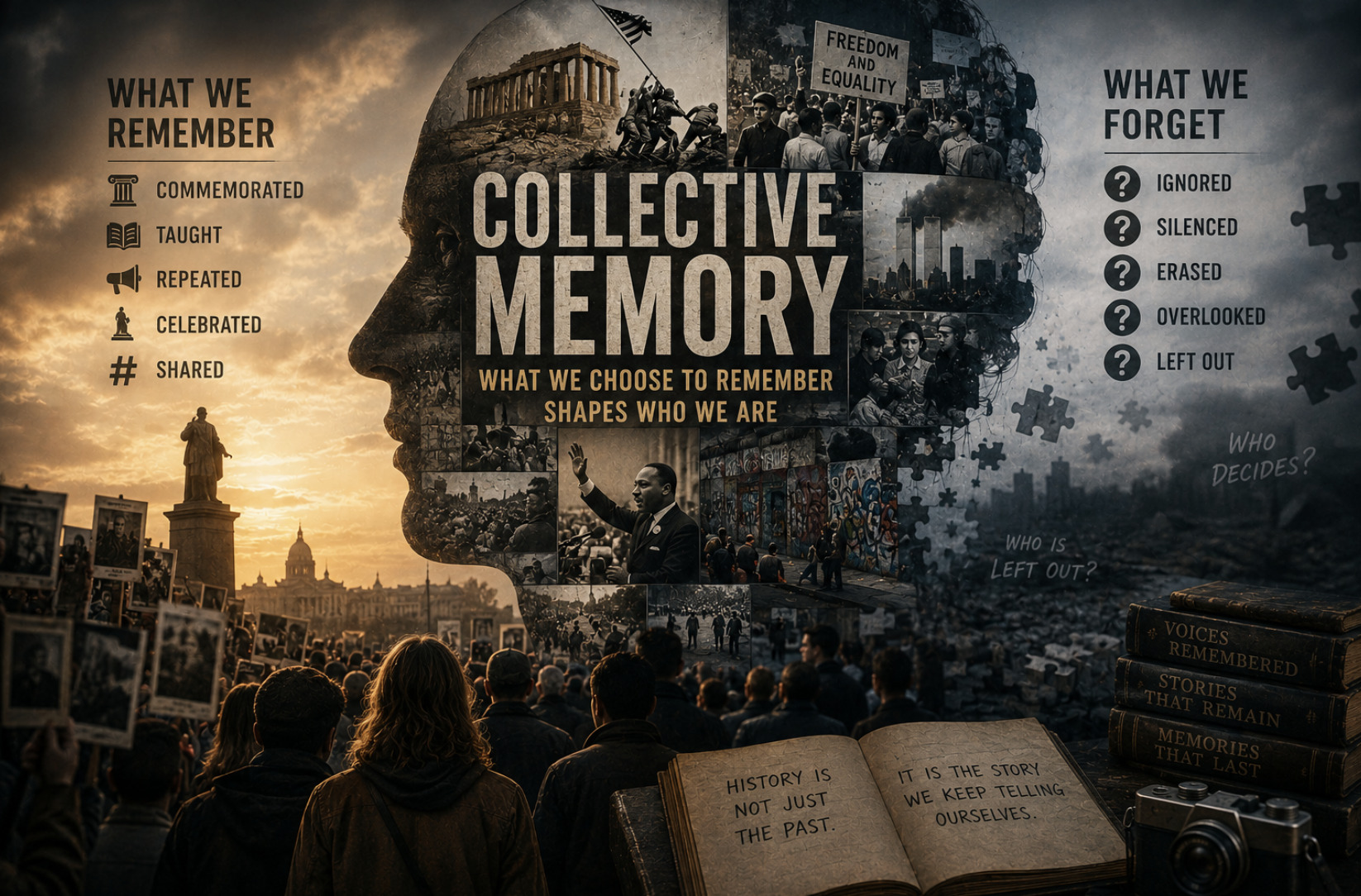
Collective memory is the shared pool of events, stories, and images that a society holds in common — and it is far from a neutral or complete record of the past. Societies remember some events vividly while forgetting others entirely, not because the remembered events were always more important, but because collective memory is actively shaped by what gets repeated, commemorated, taught, and retold, and by whose stories are given a place in the shared narrative. What a group chooses to remember and what it lets slip away reveals as much about the group's present values as about the past itself. Understanding how collective memory really works — how it forms, why it is selective, and how it changes — helps explain why the version of history most people carry is always a construction, never simply a mirror of what happened.
What collective memory is
Collective memory refers to how groups — nations, communities, cultures — remember their shared past together, as distinct from the private memories individuals hold. It is the set of events, figures, and stories that a society treats as common knowledge, the reference points that members are expected to know and that shape a shared sense of identity. Unlike personal memory, which lives in individual minds, collective memory lives in the spaces between people: in what is taught in schools, marked by monuments and holidays, retold in media and stories, and passed from one generation to the next.
The crucial thing to understand is that this shared memory is not a straightforward record of the most important things that happened. It is selective and constructed. Of the countless events in any society's past, only a small number become part of the collective memory, while the vast majority fade from shared awareness entirely. Which events make the cut is determined not purely by their historical significance but by a range of forces — repetition, commemoration, usefulness to a present-day story a society wants to tell about itself. Collective memory is therefore best understood not as a photograph of the past but as a curated selection, shaped by the needs and values of those doing the remembering.
Why some events are remembered and others forgotten
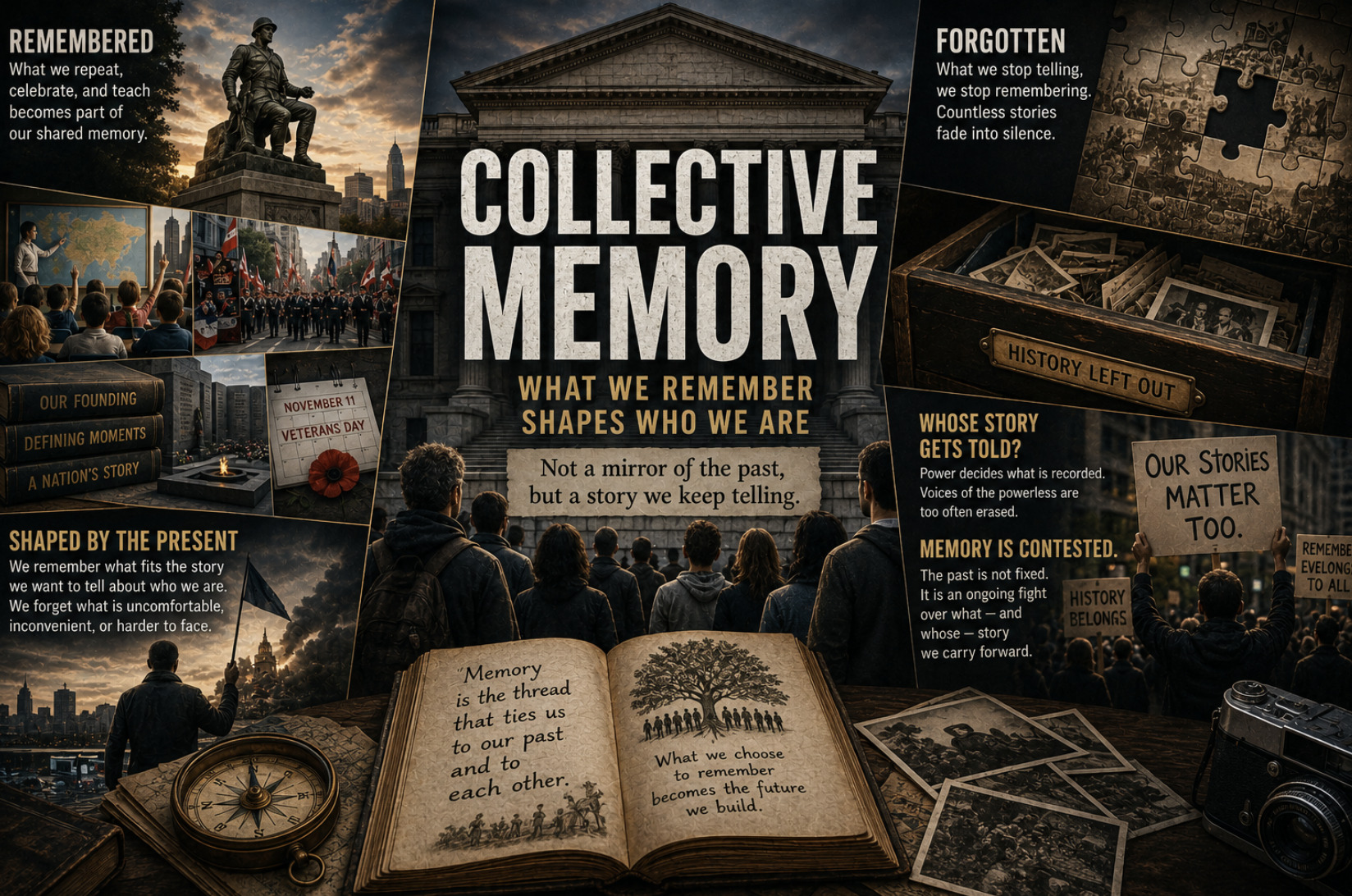
The selectivity of collective memory raises an obvious question: why these events and not those? Part of the answer is repetition and reinforcement. Events that are repeatedly commemorated, taught, depicted, and discussed become embedded in shared memory, while events that are not actively kept alive tend to fade, regardless of their original importance. Memory, at the collective level, requires maintenance — a society remembers what it keeps retelling, and forgets what it stops mentioning. This means that the effort a society puts into remembering something is often as decisive as the event itself.
The other part of the answer is that collective memory serves the present. Societies tend to remember events that fit and reinforce the story they want to tell about who they are — moments of triumph, founding narratives, defining struggles that support a shared identity — and tend to let fade events that complicate or contradict that story. This is not always deliberate; much of it happens through the quiet accumulation of what gets emphasized and what gets left out. But the result is that collective memory reflects present-day values and needs as much as past reality. What a society finds convenient, flattering, or useful to remember shapes what stays in the shared record, and what it finds uncomfortable or inconvenient often slips toward forgetting. The past that a society carries is, in this sense, always partly about its present.
Whose story gets told
A central factor in what collective memory preserves is the question of power and voice — whose experiences get recorded, repeated, and taught. Historically, the perspectives of the powerful have tended to dominate the shared record, because they controlled the institutions through which memory is maintained: the writing of history, the building of monuments, the telling of official stories. The experiences of those with less power — the marginalized, the defeated, the ordinary — have more often gone unrecorded or been pushed to the edges of collective memory, not because they mattered less but because fewer resources were devoted to keeping them alive.
This is why collective memory is frequently contested, and why struggles over memory are really struggles over whose past counts. When previously overlooked groups work to have their experiences recognized, commemorated, and taught, they are not just adding footnotes to history — they are reshaping the shared memory itself, insisting that the collective record include stories it had excluded. These contests reveal that collective memory is never finished or fixed; it is an ongoing negotiation over what belongs in the common narrative. Recognizing this helps explain why the same historical period can be remembered so differently by different groups within the same society, and why efforts to broaden or correct collective memory can be so charged. What is at stake is not merely the past, but who gets to be part of the shared story of a people.
How collective memory changes over time
One of the most important features of collective memory is that it is not static — it shifts as societies change. Events remembered one way by one generation are often reinterpreted, reemphasized, or reevaluated by the next. Figures once celebrated may later be questioned; events once ignored may later be recognized as pivotal; the meaning attached to a shared memory can transform even when the underlying facts do not. Collective memory is continually rewritten, not usually through dramatic acts of revision but through the slow process of each generation retelling the past in light of its own concerns.
This ongoing revision is why the past can seem to change even though what happened cannot. As a society's values evolve, so does what it chooses to foreground and background in its shared memory, and so does the meaning it assigns to remembered events. The same event can be a source of pride in one era and of reckoning in another, depending on the values through which it is viewed. This connects to the broader fragility of any record over time — the way information and memory require active upkeep and are vulnerable to loss and distortion, which we examined in why the internet forgets. Collective memory is a living thing, remade continually by the present, which means the history a society holds is always, in part, a portrait of the society doing the remembering.
Why understanding this matters
Grasping how collective memory works has real consequences for how we understand history and ourselves. It teaches a healthy awareness that the shared version of the past most people carry is a construction — selective, shaped by power, serving present needs, and subject to change — rather than a complete and neutral record. This awareness is not cynicism; it is literacy. It equips us to ask better questions: Why do we remember this and not that? Whose story is being told, and whose is missing? What present-day purpose does this particular version of the past serve? These questions are the beginning of thinking critically about history rather than simply absorbing it.
The deeper value is that understanding collective memory returns some agency to us. If shared memory is actively shaped rather than passively inherited, then it can be examined, questioned, and broadened — its gaps identified, its exclusions challenged, its distortions corrected. Societies that understand their memory as a construction are better able to remember more honestly and more fully, to make room for the stories that were left out, and to resist having their past quietly rewritten in ways they never chose. Collective memory will always be selective, because no society can remember everything. But being aware of how the selection happens is the difference between being shaped by a memory we never examined and taking part, consciously, in deciding what our shared past should include.
Frequently asked questions
What is the difference between collective memory and history?
History is the systematic, evidence-based study of the past; collective memory is the shared, popular sense of the past that a society holds in common. Collective memory is more selective and emotionally charged, shaped by commemoration, identity, and present needs, and it often diverges from what careful history actually shows.
Why do societies forget important events?
Because collective memory requires active maintenance — repetition, commemoration, teaching — and events that aren't kept alive tend to fade regardless of importance. Societies also tend to let fade events that complicate the story they want to tell about themselves, so significance alone doesn't guarantee something is remembered.
Can collective memory be wrong?
Collective memory is less "wrong" than selective and shaped. It emphasizes some things, omits others, and assigns meanings that serve the present, so the shared picture of the past can be incomplete or distorted even when individual facts are accurate. That's why comparing it against careful history matters.
Why does the same event get remembered differently by different groups?
Because collective memory reflects whose perspectives are recorded and repeated, and different groups have different experiences, values, and stakes in the past. Struggles over memory are often struggles over whose story counts, which is why one period can be remembered as pride by some and reckoning by others.