
The Streisand Effect: Why Trying to Hide Information Makes It Spread
By MHB Admin ·
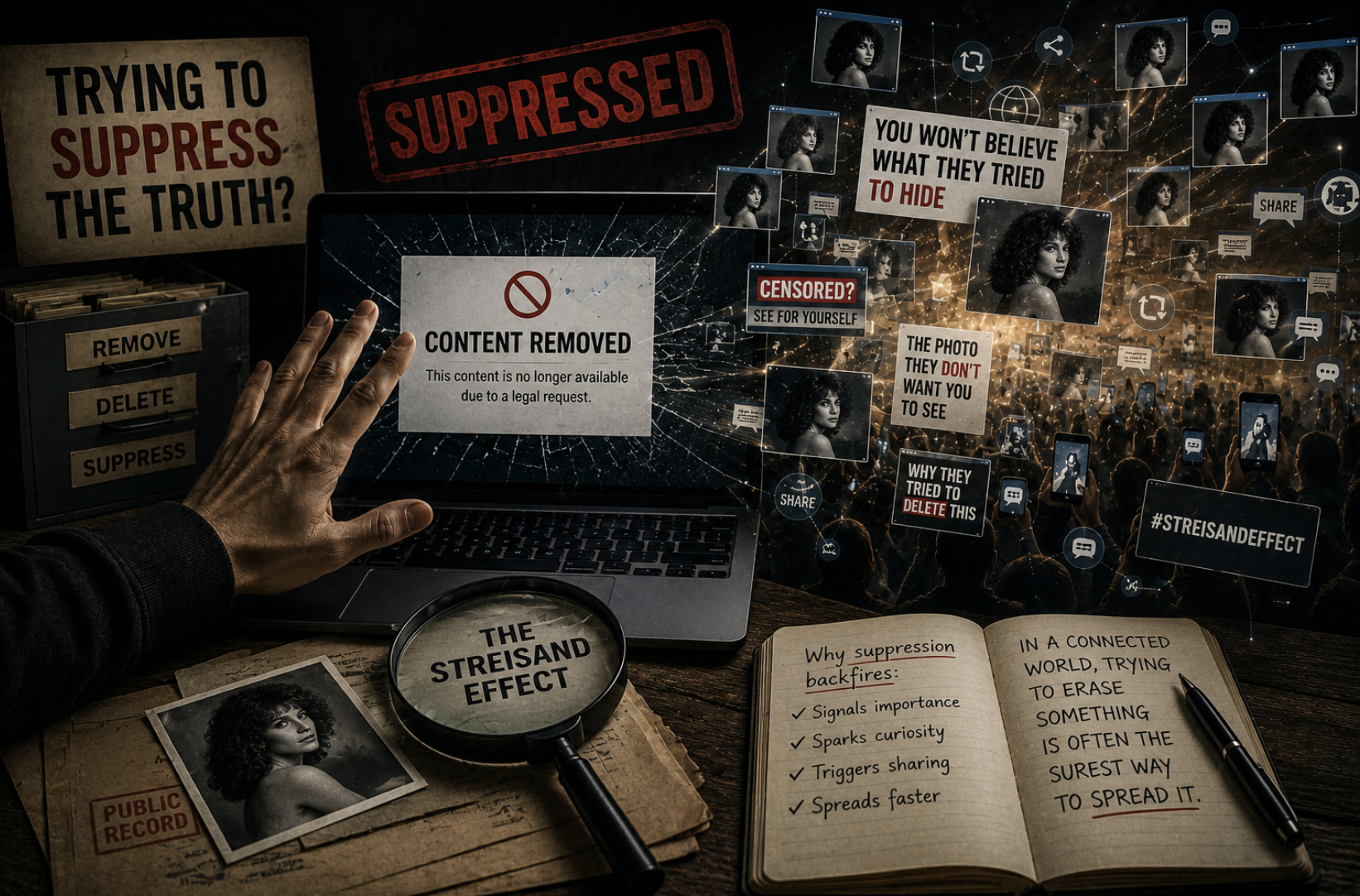
The Streisand effect is the phenomenon in which an attempt to hide, remove, or censor a piece of information ends up drawing far more attention to it than it would ever have received otherwise. The very act of trying to suppress something — a photo, a document, a story — signals that it matters, provokes curiosity, and often triggers a wave of sharing that makes the information impossible to contain. Named after a famous case in which an attempt to remove a single photograph caused it to be seen by an enormous audience, the effect has become one of the defining dynamics of the internet age. Understanding why suppression so reliably backfires reveals something important about how information behaves online — and why, in a connected world, trying to erase something is often the surest way to spread it.
What the Streisand effect actually is
At its core, the Streisand effect describes a specific and counterintuitive reversal: the effort to reduce attention to something produces the opposite result. Someone wants a piece of information gone — they find it embarrassing, damaging, or private — and they take action to remove or censor it. But that action itself becomes the story. People notice the attempt to hide something and immediately wonder what is being hidden and why, and that curiosity drives them to seek out, view, and share the very thing that was supposed to disappear. What might have remained obscure becomes widely known precisely because someone tried to bury it.
The name comes from a well-known incident in which an attempt to suppress a single, largely ignored photograph led to it being viewed by a vast number of people who would otherwise never have encountered it. The image had been sitting quietly, seen by almost no one; the legal effort to remove it turned it into news, and the news turned it into something everyone wanted to see. The case became the archetype, and the pattern it illustrated was given its name. Since then, the same dynamic has played out countless times, wherever someone powerful enough to attempt suppression underestimates how the attempt itself will be received.
Why suppression backfires
The reason the effect is so reliable comes down to human psychology and the nature of attention. People are naturally curious about things that are hidden from them; the sense that information is being kept secret makes it more interesting, not less. When someone tries to censor or remove something, they are effectively announcing that it is significant enough to hide — and that announcement is an irresistible invitation. The suppression attempt acts as a signal that says "this matters," and that signal draws exactly the attention it was meant to prevent.
There is also a strong element of reaction against the censorship itself. Many people instinctively dislike attempts to control what they can see and know, and respond to suppression not with compliance but with defiance — sharing the information specifically because someone tried to stop them. What began as a private embarrassment becomes a matter of principle, a small act of resistance against being told what to look at. This combination — curiosity about the hidden plus resentment of the censorship — is what turns a quiet attempt to remove something into a loud, widely shared story. The person attempting suppression is fighting not just the information, but the predictable human tendencies that their own actions have provoked.
Why the internet makes it worse
The Streisand effect existed before the internet in principle, but the internet made it vastly more powerful, and understanding why is essential to understanding the modern version. Online, information can be copied and redistributed almost instantly and infinitely. The moment something exists digitally, it can be saved, screenshotted, mirrored, and reposted by anyone, anywhere, in seconds. This means that by the time someone tries to remove a piece of information, copies may already exist far beyond their reach — and the attempt to remove the original simply motivates people to spread those copies further.
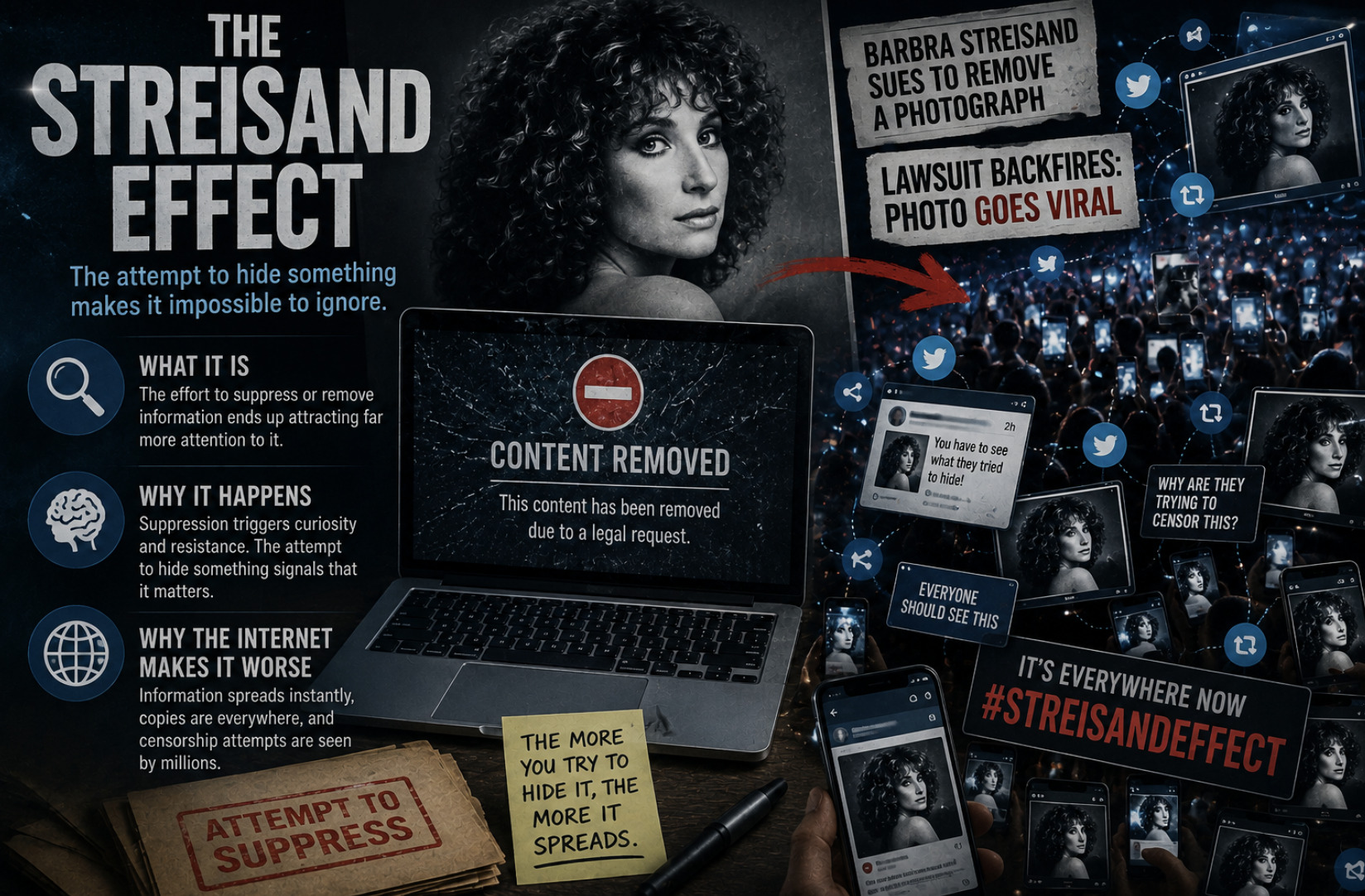
This is the crucial modern reality: once information is online and has been noticed, it is extraordinarily difficult to truly erase. Trying to delete it from one place does nothing about the copies elsewhere, and the deletion attempt itself alerts more people to go and make new copies. The internet's architecture of easy duplication turns suppression into a race the censor cannot win, because every act of removal can be outpaced by acts of copying. This is closely related to the broader difficulty of controlling digital information at all — a theme we explored in how the internet remembers and forgets — but here the dynamic runs in the opposite direction: instead of information quietly vanishing, the attempt to make it vanish keeps it alive and spreads it wide.
The lesson for anyone trying to control information
The practical lesson of the Streisand effect is a hard one for anyone who wants to suppress information: the attempt often causes exactly the harm it was meant to prevent, only bigger. Faced with something embarrassing or damaging online, the instinct is to demand its removal — but that instinct frequently makes the situation far worse, converting a small, obscure item into a widely known story. The calculation that suppression will contain the damage ignores how the suppression itself becomes the news, and how the internet's copying dynamics make containment nearly impossible.
This doesn't mean nothing can ever be removed or that suppression always backfires — sometimes quiet, unpublicized removal succeeds, particularly before anything has been noticed. But once information has drawn any attention, aggressive attempts to erase it carry enormous risk of triggering the effect. Those who understand this often choose a different strategy entirely: rather than trying to suppress unwanted information and risk amplifying it, they respond to it, contextualize it, or simply let it fade on its own, denying it the oxygen that a dramatic removal attempt would provide. The counterintuitive wisdom is that sometimes the most effective way to reduce attention to something is to do nothing at all, because in a world of infinite copies and reflexive curiosity, the fight to hide something is very often the thing that makes everyone look.
What the effect reveals about our information world
Beyond its practical lessons, the Streisand effect tells us something deeper about the age we live in. It reveals that control over information has fundamentally shifted. In earlier eras, those with power could often successfully suppress what they didn't want known, because information moved slowly and through channels they could influence. Today, the ease of copying and the speed of sharing have distributed that power widely, and attempts at top-down suppression collide with a system designed to route around them. The effect is, in a sense, a symptom of how difficult centralized control of information has become.
This is worth sitting with, because it cuts in more than one direction. The same dynamic that frustrates censorship and protects information from being quietly buried also means that private, personal, or genuinely harmful material can be equally impossible to contain once it spreads — a reality with real human costs. The Streisand effect is neither purely good nor purely bad; it is a structural feature of a world where information, once loose, resists being caught. Understanding it helps us navigate that world more wisely, whether we are trying to bring something to light, protect something private, or simply make sense of why the things people most want hidden so often become the things everyone ends up seeing. In the memory of the internet, the surest way to be remembered is sometimes to demand to be forgotten.
Frequently asked questions
Where does the name "Streisand effect" come from?
It comes from a well-known case in which an attempt to remove a single, largely unnoticed photograph caused it to be viewed by an enormous audience who would otherwise never have seen it. The incident became the archetype for the phenomenon, and the effect was named after it.
Why does trying to hide information make it spread?
Because the attempt to hide something signals that it's important, which sparks curiosity, and because many people react to censorship with defiance, sharing the information specifically because someone tried to stop them. Together, curiosity and resistance turn a quiet item into a widely shared story.
Can anything be removed from the internet without triggering the effect?
Sometimes, especially if information hasn't yet drawn attention and is removed quietly. But once something has been noticed, aggressive attempts to erase it risk amplifying it dramatically, because copies spread faster than they can be deleted and the removal attempt itself becomes news.
How should you respond to unwanted information online?
Often the wiser approach is not aggressive suppression but responding, adding context, or letting it fade naturally, since a dramatic removal attempt can draw far more attention than the original. In a world of infinite copies, the fight to hide something frequently makes more people look.