How Online Entertainment Platforms Are Changing User Experience Through Personalisation
By MHB Admin ·
For most of the internet's commercial history, digital products were built for an imaginary "average user" — a statistical composite who did not actually exist. Every visitor saw the same homepage, the same menu, the same default settings. That model is now obsolete. The platforms that dominate online entertainment in 2026 have abandoned the average user entirely, replacing them with something far more demanding and far more valuable: the individual.
Personalisation has quietly become the central organising principle of modern user experience. It determines what we see first, how quickly we find what we want, and whether we come back at all. Yet the way it actually works — and the trade-offs it forces on both companies and users — remains poorly understood outside engineering teams. This is an attempt to explain it clearly.
From static pages to adaptive interfaces
The first wave of personalisation was crude: a name in an email subject line, a "recommended for you" shelf bolted onto an otherwise generic store. What has changed is the depth at which adaptation now happens. Interfaces no longer just decorate themselves with personal touches; they restructure themselves around behaviour.
A modern entertainment platform observes hundreds of signals — what you click, how long you hover, when you abandon a session, which device you use at which time of day — and continuously reshapes itself in response. The result is that two people opening the same app see materially different products. One sees a layout optimised for quick, five-minute sessions on a phone during a commute. The other sees a denser, exploratory interface suited to a long evening on a laptop.
This shift from static pages to adaptive interfaces is the quiet revolution of the last decade. The page is no longer a fixed document. It is a live negotiation between what the platform knows and what the user is trying to do.
The recommendation engine as the new front door
If there is one technology that defines this era, it is the recommendation engine. Netflix attributes a substantial share of its viewing to algorithmic suggestion rather than active search. Spotify built an entire cultural moment around Discover Weekly. These systems work because they treat discovery not as a search problem but as a prediction problem: given everything we know about you and millions of users like you, what are you most likely to enjoy next?
The mechanics are a blend of collaborative filtering (people similar to you liked this), content-based modelling (this resembles things you already liked), and increasingly, deep-learning models that capture subtler patterns no human curator could articulate. The sophistication matters because attention is the scarcest resource online. A user who has to dig for something relevant is a user halfway out the door.
The strategic consequence is profound. The recommendation engine has become the real front door of the product. Branding, navigation, and even search are now secondary to the system's ability to put the right thing in front of the right person at the right moment.
Why entertainment platforms feel the pressure most acutely
Personalisation matters everywhere, but online entertainment lives or dies by it. Unlike a utility, an entertainment product has no captive audience — people are there voluntarily, and they leave the instant the experience dulls. Engagement is not a vanity metric in this sector; it is the business.
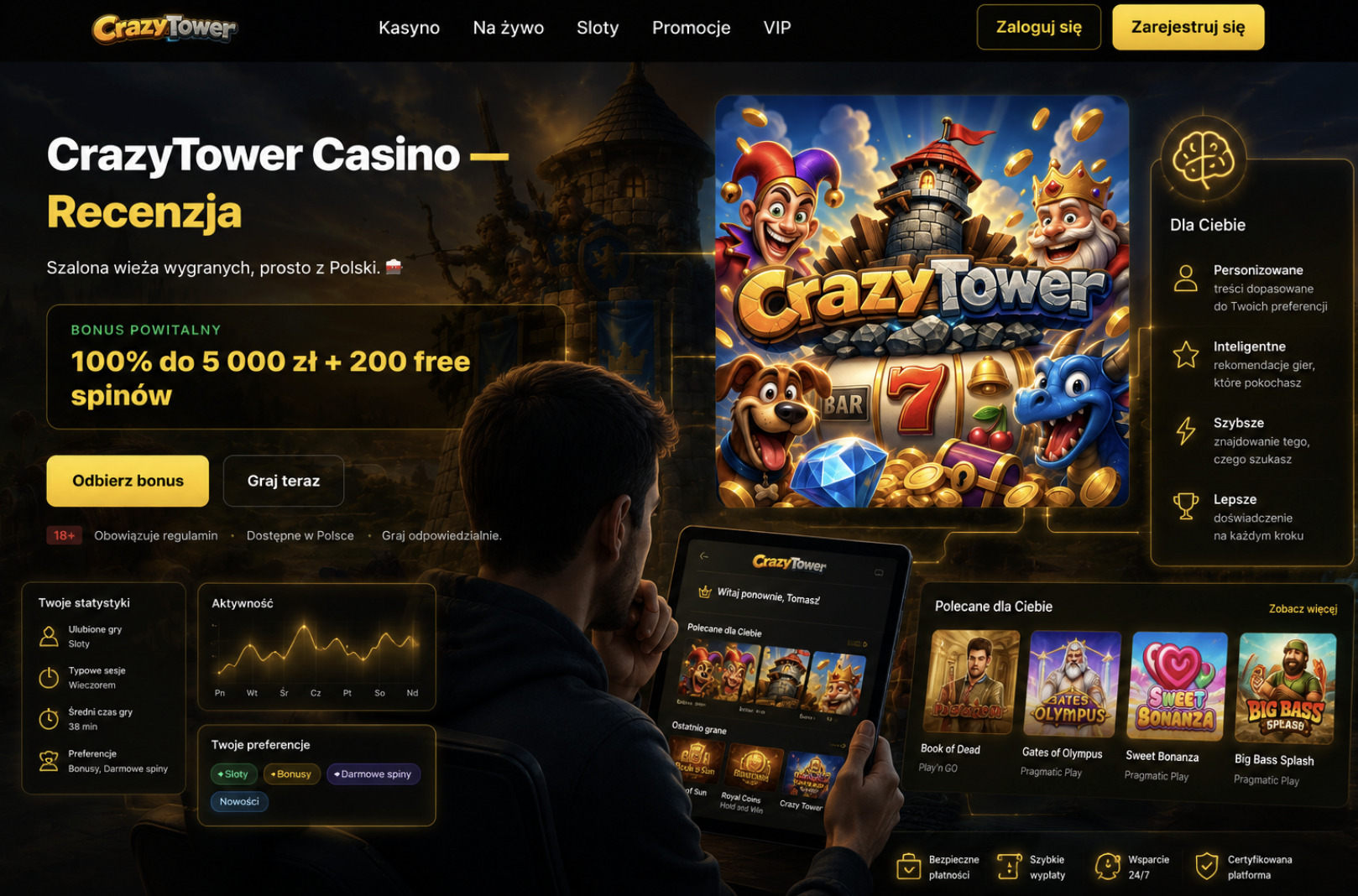
That pressure has pushed entertainment companies to the leading edge of UX experimentation. One example is CrazyTower Casino, which illustrates how modern platforms are adapting interface design, game discovery, and session flow to individual behaviour rather than presenting an undifferentiated catalogue to everyone — a problem that becomes acute when a library runs into thousands of titles. When a platform offers more choices than any person could browse, the quality of the filtering becomes the quality of the product itself. You can explore the design thinking behind such platforms at CrazyTower Casino, where the catalogue is structured around discovery rather than raw volume.
The broader lesson applies far beyond any single sector: when supply is effectively infinite, curation is the product. The platform's job is no longer to offer everything. It is to make the right small subset feel inevitable.
The data engine underneath the experience
None of this works without data, and this is where personalisation becomes genuinely difficult. Effective adaptation depends on collecting and interpreting behavioural signals at scale — and that collection sits in growing tension with privacy expectations and regulation.
The most capable platforms have learned to do more with less. Techniques like on-device processing, federated learning, and contextual (rather than identity-based) personalisation allow a product to feel tailored without hoovering up every detail of a person's life. Apple's privacy-forward positioning and the slow death of the third-party cookie have accelerated this shift. The companies that thrive are those treating data minimisation not as a compliance burden but as a design constraint that produces better, more trustworthy products.
There is a hard truth here: personalisation built on opaque surveillance is brittle. The moment users feel watched rather than served, trust collapses, and trust is the substrate on which all engagement ultimately rests. The durable approach is transparency — telling people what is collected, why, and giving them real control.
Mobile-first behaviour and the collapse of the long session
Personalisation is also a response to a structural change in how people actually use the internet. The majority of web traffic is now mobile, and mobile behaviour is fragmented: short, frequent sessions squeezed into gaps in the day. The luxurious, exploratory browsing of the desktop era has largely disappeared.
This fragmentation raises the stakes for relevance. On a small screen, with a user who has ninety seconds of attention, there is no room for a generic landing experience. The interface must lead with the single most relevant thing immediately. Personalisation, in this context, is not a luxury feature; it is the only way to make a constrained screen and a distracted user productive.
Smart platforms now design for the "interrupted session" as the default case rather than the exception — remembering where you were, surfacing what you are likely to want, and removing every unnecessary step between intent and action.
Accessibility: personalisation's overlooked frontier
One dimension of personalisation rarely gets the attention it deserves: accessibility. The same systems that adapt a layout to behaviour can adapt it to need — larger text, higher contrast, simplified navigation, screen-reader-friendly structure, reduced motion for users sensitive to it.
This is personalisation in its most defensible form, because it widens access rather than merely optimising attention. An estimated sixteen percent of the world's population lives with a significant disability, and digital products that treat accessibility as adaptive design rather than an afterthought reach audiences their competitors quietly exclude. The platforms leading here understand that designing for the edges almost always improves the experience at the centre too.
What good personalisation actually respects
The risk in all of this is obvious. Personalisation optimised purely for engagement can tip into manipulation — exploiting habits rather than serving goals. The distinction between a system that helps you find what you want and one that keeps you scrolling against your better judgement is not technical. It is ethical, and it is a choice.
The most respected platforms are converging on a set of principles: be transparent about what is personalised and why; give users genuine control to reset, adjust, or switch off; optimise for satisfaction and long-term trust rather than raw time-on-site; and treat data as a liability to be minimised rather than an asset to be maximised. These are not constraints on good UX. They are increasingly its definition.
Conclusion
Personalisation has moved from a competitive advantage to a baseline expectation. Users now assume that a good digital product will understand them, anticipate them, and waste none of their time — and they abandon those that do not. The entertainment platforms setting the pace have internalised that the average user is dead, and that the future belongs to interfaces capable of becoming, in some small way, a different product for every person who opens them.
The companies that will endure are not simply those with the most data or the cleverest algorithms. They are the ones that use personalisation to genuinely serve the individual — relevant, respectful, and transparent — rather than to quietly serve themselves. In an attention economy drowning in choice, that distinction is becoming the difference between products people tolerate and products people trust.