The Data Brokers Who Know Everything About You and Answer to No One
By MHB Admin ·
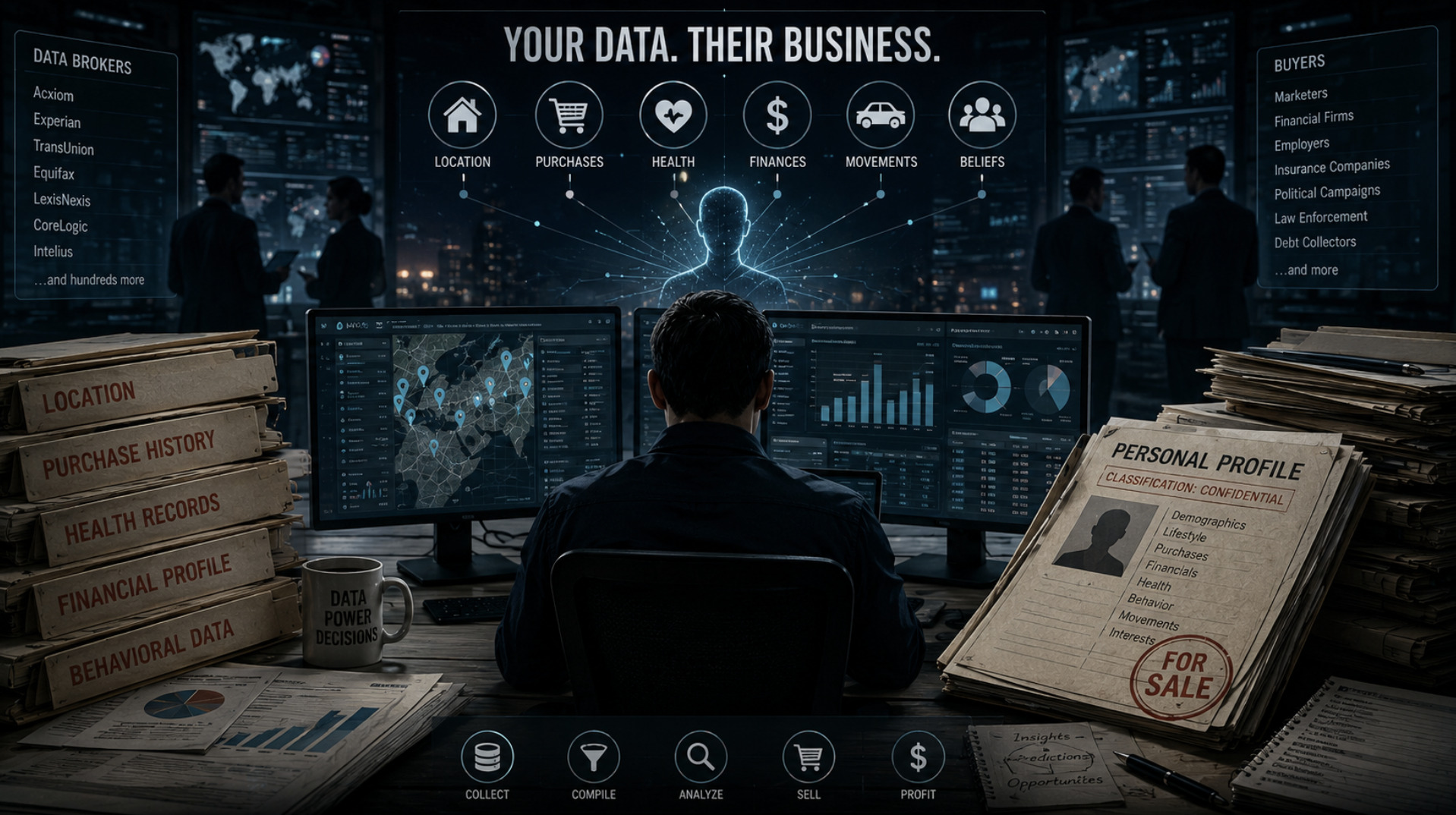
There is an entire industry built around you that you have never knowingly interacted with, whose products are dossiers about your life, and whose customers are anyone willing to pay. It is the data broker industry, and it operates in a deliberate obscurity that is central to how it works. These companies compile detailed profiles on hundreds of millions of people — where you live, what you buy, your health concerns, your finances, your movements, your inferred beliefs — and sell them, and most of the people being profiled have no idea any of it is happening. It is one of the largest and least examined systems of surveillance in modern life, and it runs almost entirely outside public awareness or meaningful accountability.
The industry you never signed up for
The defining feature of data brokers is that you have no relationship with them, and that is the whole point. You did not create an account, agree to their terms, or hand them your information directly. Instead, they gather it from countless sources scattered across your ordinary life and assemble it into a profile you never authorised and usually cannot see. The absence of any direct interaction is exactly what lets the industry operate unnoticed — there is no login, no bill, no moment where you consented to being catalogued.
That structure inverts the normal understanding of privacy. Most people picture privacy as a matter of what they choose to share with the services they use, and they weigh those choices, however imperfectly. Data brokers sit entirely outside that frame. They aggregate information about you from the edges of your life, without your participation, into a comprehensive record held by companies whose names you would not recognise. You are their product, not their customer, and the transaction that turns your life into a saleable file happens without you ever being at the table. It is a more systematic and less visible version of the monitoring we examined in the surveillance creep turning ordinary jobs into monitored lives — only here the watching follows you everywhere, not just to work.
Where the profile comes from
The detail in these dossiers can be unnerving, and it is worth understanding how ordinary the sources are, because that is what makes the practice so hard to escape. The raw material comes from the routine traces everyone leaves: public records like property and court filings, the vast trail of online activity, purchase histories, loyalty programmes, app data, and countless commercial transactions. Individually, each of these is a small, unremarkable fact. The broker's business is combining them.
That combination is where the real power lies. On their own, the fragments say little; assembled, they form a startlingly complete picture, and brokers go further still by using the known facts to infer new ones — deducing your likely health conditions, financial situation, life events, and personal traits from patterns in the data. A profile can end up asserting things about you that you never disclosed anywhere, because they were guessed from everything else. The result is a dossier that is both broader and more intrusive than any single source, capable of characterising your health, your money, your relationships and your vulnerabilities, all derived from the residue of normal life. And because the inputs are the unavoidable exhaust of participating in modern society, there is no clean way for an individual to simply opt out of generating them.
Who buys it, and what can go wrong
A profile is only as consequential as what is done with it, and the list of buyers is long and varied: advertisers, certainly, but also employers, landlords, insurers, financial companies, and others making real decisions about people's lives. This is where an abstract privacy concern becomes concrete harm. When a dossier assembled without your knowledge feeds into whether you get a job, an apartment, a loan, or an insurance rate, the stakes stop being theoretical. Decisions that shape your opportunities can be influenced by data you never saw and cannot correct.
The dangers compound because you have no window into the process. The information brokers hold can be wrong — assembled from imperfect sources and speculative inferences — and you have little ability to see it, challenge it, or fix it, even as it is used to judge you. A mistaken inference about your health or finances can follow you invisibly. Worse, the sensitivity of the data creates acute risks in the wrong hands: detailed profiles enable precisely targeted scams and manipulation, and can expose people to real danger when information like their location or vulnerabilities is available for purchase. A system that quietly builds and sells intimate records, with no reliable way for the subject to verify or correct them, is a system primed to cause harm that its victims cannot even trace back to a source — much like the erosion of accountability we documented in how FOIA became slower, weaker and less effective.
The accountability gap
The reason all of this persists is a profound mismatch between the industry's power and its accountability. Data brokers exert real influence over people's lives while operating largely in the shadows, subject to little of the oversight or transparency that their reach would seem to demand. The people being profiled cannot see the profiles, cannot easily correct them, and in many cases cannot even learn which companies hold data about them. Power without visibility, and influence without answerability, is the defining condition of the sector.
That gap is not accidental; it is the environment in which the business thrives. Obscurity is a feature, because a system that profited from turning lives into products would find scrutiny inconvenient, and it has largely avoided it. The first and most necessary response is simply awareness — recognising that this industry exists, understands you in granular detail, and shapes decisions about you without your knowledge or consent. It is a textbook case of the kind of consequential machinery that runs quietly beneath public attention, precisely the sort of overlooked power worth dragging into the light. You cannot demand accountability from a system you do not know is there, and for the data broker industry, that unfamiliarity has long been the best protection it has.
Frequently asked questions
What is a data broker? A data broker is a company that compiles detailed profiles on hundreds of millions of people — covering things like where they live, what they buy, their finances, health and movements — and sells that information to buyers such as advertisers, employers, landlords and insurers. Most people profiled have never interacted with these companies and are unaware they exist.
Where do data brokers get their information? From the ordinary traces people leave: public records, online activity, purchase histories, loyalty programmes, app data and commercial transactions. Individually these are minor facts; brokers combine them into a comprehensive profile and use the known data to infer new details, such as likely health conditions or financial situations, that you never disclosed.
Why are data brokers a problem? Because their profiles can feed into consequential decisions — jobs, housing, loans, insurance — using information you never saw and cannot correct, even though it may be wrong. The sensitive data also enables targeted scams and can expose people to danger, all while the industry operates with little transparency or accountability to the people it profiles.