
News Deserts: The Stories That Vanish Before They're Told
By MHB Admin ·
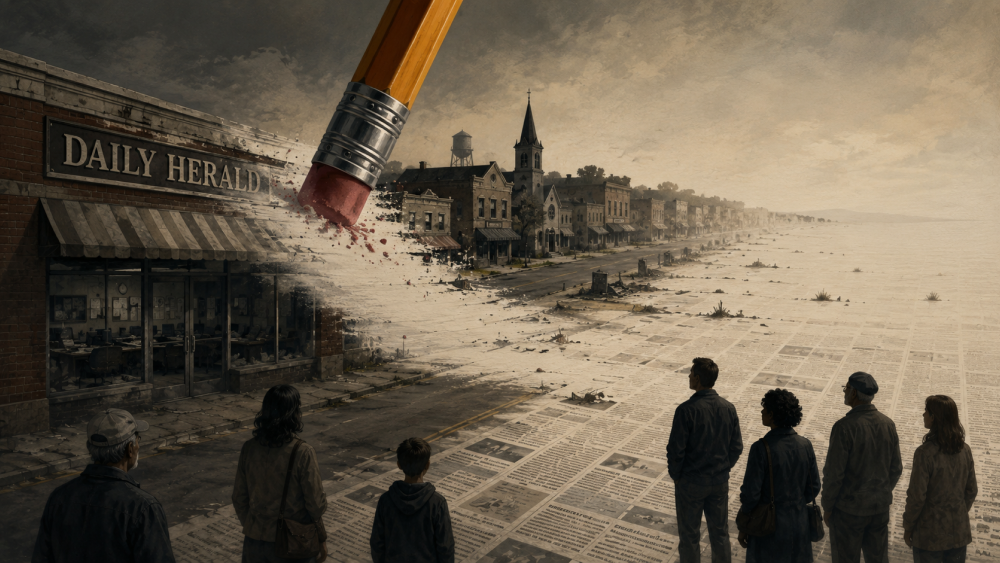
The disappearance of a newspaper is one of the few civic catastrophes that erases its own coverage. When a factory closes, reporters write about the layoffs. When a hospital shuts, there is a story about the patients left stranded. But when the local paper folds, the institution that would have chronicled the loss is itself the loss. The hole it leaves is not only in the news; it is in the record of what happened, and increasingly in the public's memory that anything was ever there to lose.
A third of the country's papers, gone
The collapse is not gradual or genteel. According to Northwestern University's Medill State of Local News project, nearly 40 percent of all local newspapers in the United States have vanished since 2005. Around 5,600 remain, and roughly four in five of those are weeklies. In the most recent year studied, 136 more disappeared through closure or merger — a pace, sustained over two decades, of more than two a week.
The result is a map pocked with holes. Medill counts 213 counties that are full "news deserts," with no locally based source of original news at all. Another 1,524 counties are down to a single outlet, often a thinning weekly that cannot possibly cover everything within its borders. Taken together, that leaves roughly 55 million Americans with little or no access to news about the place they actually live.
The deserts have a geography
These blank spaces are not randomly distributed. Close to 80 percent of news-desert counties are rural, and their residents tend to be older, poorer, and less formally educated than the national average. The communities with the fewest resources to spin up a replacement — a digital startup, a nonprofit newsroom, a public-radio bureau — are precisely the ones losing coverage first. Where the need for a watchdog is greatest, the watchdog leaves earliest.
What disappears with the reporter
It would be comforting to treat this as a story about a dying industry, a sad-but-private business failure like the corner video store. It isn't. A growing body of research shows that when the reporter leaves, measurable harm follows — and almost none of it makes the news, because the entity that would report it is the one that's gone. The documented consequences include:
Public money gets more expensive. In the study "Financing Dies in Darkness?", finance researchers at the University of Illinois–Chicago and Notre Dame found that after a local newspaper closes, municipal borrowing costs rise by roughly 5 to 11 basis points over the long run — a gap that can cost the average resident on the order of $70, simply because lenders price in the risk of a government no one is watching.
Fewer people bother to run. When the Cincinnati Post closed in 2007, researchers found that in the communities it had covered most, fewer candidates ran for municipal office, incumbents grew more likely to win, and both turnout and campaign spending fell.
Competition and turnout decline. A study matching California newspapers to the towns they cover found that sharp cuts to newsroom staffing were followed by reduced competition in mayoral races and lower voter participation.
Corruption goes unchallenged. Across this literature, the same pattern recurs: with no one calling city hall to account, officials grow lazier, spending grows looser, and bad behavior that a beat reporter would once have flagged simply proceeds unflagged.
None of these were front-page scandals. They are the quiet compounding interest of an absent witness — costs paid by people who never learn they are paying them.
The ghost in the masthead
Closures are only the visible edge of the problem. The subtler danger is the "ghost newspaper": a title that still lands on doorsteps but has been hollowed out by years of cuts until it no longer staffs the school board, the zoning hearing, or the county courthouse. A paper can keep running wedding announcements and high-school box scores long after it has stopped covering how power is actually used. By the headcount, the community still has a newspaper. By the only measure that matters, it has a desert with a logo.
The story that never gets written
This is where a publication devoted to overlooked and misreported stories has to confront its own limits — and its reason for existing. A news desert never announces itself. The contract steered to a commissioner's relative, the slow leak from the plant upriver, the tax abatement waved through on a sleepy Tuesday night: in a healthy ecosystem these become reporting, then perhaps controversy, then memory. In a desert they become nothing. There was no one in the room to write the first draft, so there is no draft to revisit, correct, or remember.
That is the purest version of the memory hole. Not facts buried after the fact, but facts that never enter the record at all. A blog like this one can re-examine what was distorted and recover what was forgotten. It cannot resurrect what was never witnessed. The deepest threat of the news desert is not that we will misremember our own communities. It is that, across a widening share of the country, there will be nothing to misremember — only the silence where the story should have been.