The Biggest Property Crime Nobody Calls Crime
By MHB Admin ·
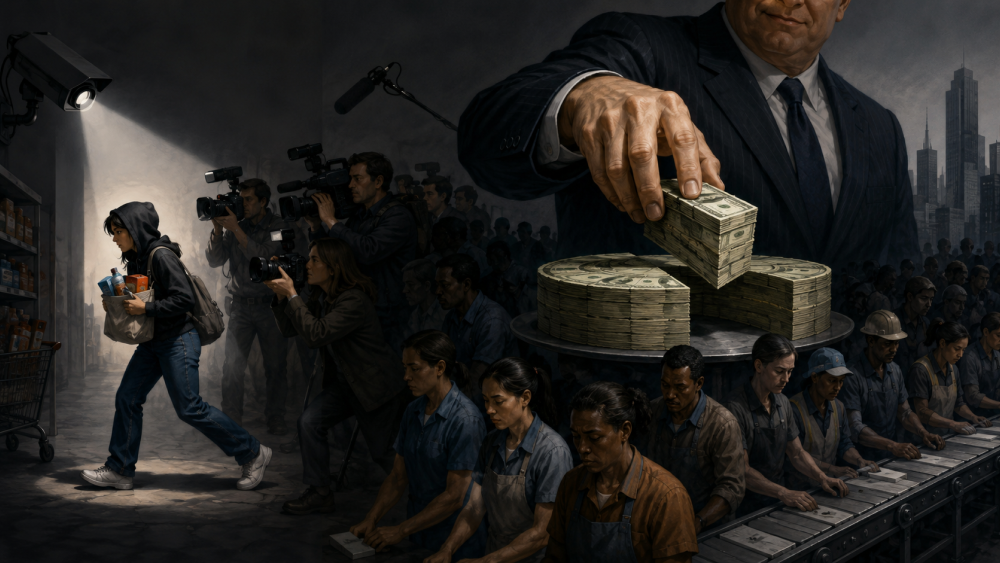
The media obsesses over shoplifting while the far larger theft — employers stealing wages from workers — goes uncounted, unpunished, and unnamed as crime.
Switch on the local news and you will eventually meet the crime wave. Smash-and-grab raids, emptied pharmacy shelves, lurid security-camera footage of someone walking out of a chain store with an armful of merchandise. Retailers convene press conferences, politicians promise task forces, and the footage loops until "retail theft" feels like the defining lawlessness of the age. Almost none of this coverage mentions the larger theft happening in the same economy, every day, in plain sight — the one committed by employers against the people who work for them.
The numbers are not close. The Economic Policy Institute estimates that minimum-wage violations alone cost American workers roughly $15 billion a year. Add unpaid overtime, stolen tips, off-the-clock work, illegal deductions and misclassification, and credible estimates of total wage theft climb toward $50 billion annually. Set that against the FBI's own tally: the combined value of all robberies, burglaries, larcenies and motor-vehicle thefts in the country runs to somewhere between $13 and $16 billion. By the government's own bookkeeping, employers steal more from workers than every burglar, mugger and car thief in America put together — and it isn't even a contest.
You would never know it from where the cameras point. Shoplifting gets ride-alongs, dedicated retail-crime units and breathless cable segments. Wage theft gets a civil complaint form. The asymmetry is not an accident of news judgment; it follows from a deeper decision about whose taking counts as a crime. When a teenager pockets a phone charger, that is theft, full stop, with a perp walk to match. When a restaurant skims an hour off every server's timesheet, or a contractor pays cash at straight time for sixty-hour weeks, that is reclassified into the bloodless language of "disputes," "back wages" and "compliance issues." The act is the same — taking money that belongs to someone else — but only one version gets the word.
Enforcement tells the rest of the story. The Department of Labor's Wage and Hour Division recovered around $273 million in back wages in fiscal 2024, and a comparable figure the following year. Against a problem estimated in the tens of billions, that is a rounding error — pennies clawed back on the dollar, and only for the small minority of workers who ever file. Most never do. They don't know the law, they fear retaliation, they need the job, or they simply assume nothing will come of it. The recovered money is not the size of the crime. It is the size of our indifference to it.
There is no mystery about why the data goes down the memory hole. The figures are not buried — the FBI publishes the property-crime totals, the Labor Department publishes its recoveries, the Economic Policy Institute publishes the estimates. The information is sitting in public view. What's missing is the will to remember it, because wage theft refuses to fit the story the culture wants to tell about crime. There is no menacing stranger, no broken window, no police chase. The perpetrator is often a respectable business with a payroll department. The victims are the people least able to absorb the loss and least likely to be believed. None of it photographs well, and none of it confirms the comfortable narrative that disorder flows upward from the poor rather than downward onto them.
A few cracks have appeared. California now treats large-scale intentional wage theft as grand theft rather than a paperwork lapse, and members of Congress have floated bills to make it a federal felony. Whether any of that survives contact with the lobbying that follows is another question. But the deeper fix isn't legislative; it's a matter of attention. We already know how to recognize theft when a stranger does it to a store. The harder, more honest thing is to recognize it when an employer does it to a worker — to grant that the larger crime is the one we have agreed, collectively and conveniently, not to see.