Guilty Property, Innocent Owner: The Quiet Machinery of Civil Forfeiture
By MHB Admin ·
There is a genre of court case with names that read like absurdist theater: United States v. $124,700 in U.S. Currency. State v. One 1990 Toyota. The defendant in these cases is not a person. It is an object. And the reason the object is on trial, rather than a human being, is one of the most quietly radical arrangements in American law — a system in which the government can take your property without ever proving, or even alleging in criminal court, that you did anything wrong.
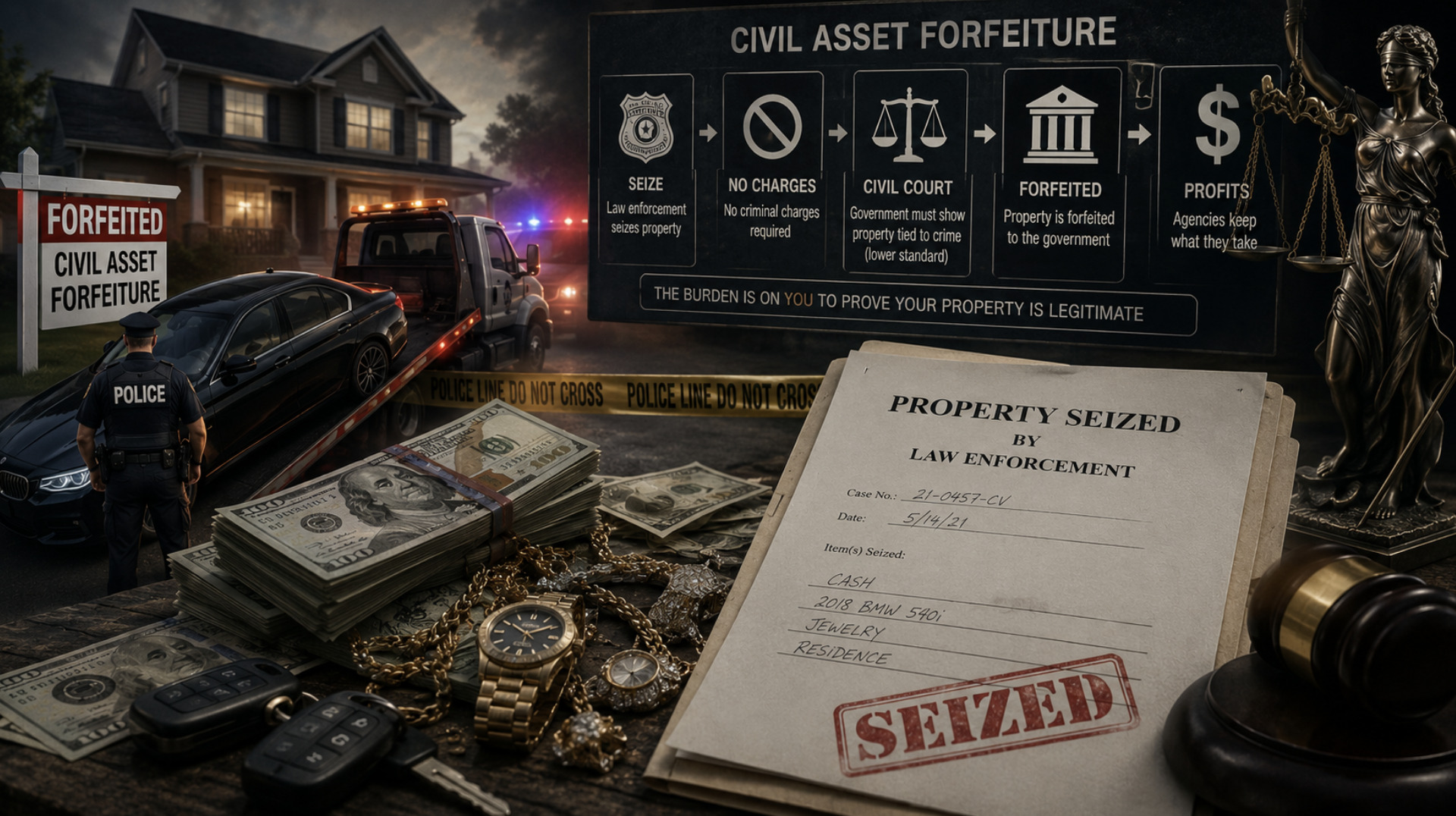
Civil asset forfeiture rests on a legal fiction inherited from centuries-old maritime law: that property itself can be "guilty." Because the case is filed against the thing rather than the owner, the constitutional protections that attach to a criminal defendant largely evaporate. There is no presumption of innocence for a bundle of cash. There is no right to an attorney for a seized car. In many jurisdictions the burden flips entirely, so that it falls to the owner to prove their property was not connected to a crime — to prove a negative, often without a lawyer, against a government that already has their money.
The mechanism would be a curiosity if it were rare. It is not. By the accounting of the Institute for Justice, which has tracked the practice for years in its Policing for Profit reports, forfeiture has moved billions of dollars from citizens to law enforcement agencies, frequently without any accompanying conviction. A great deal of it involves sums too small to fight: a few thousand dollars in cash, the cost of hiring a lawyer to recover it exceeding the amount seized. The rational choice, for most people, is to walk away. The system is engineered around that calculation.
What turns a dubious legal theory into a machine is the money. In many states and under the federal program, the agency that seizes the property gets to keep some or all of the proceeds, funneling them back into its own budget. This is not a side effect; it is the engine. When a sheriff's department can fund its equipment, overtime, and operations through the cash it takes off the people it stops, the incentive is no longer public safety but revenue. Studies have found departments leaning harder on forfeiture when their budgets tighten — policing, in other words, shaped by what pays.
The most telling detail is how the system defends itself against reform. When states have moved to restrict forfeiture or require a criminal conviction first, agencies have routinely sidestepped the new rules through "equitable sharing," a federal arrangement that lets local police partner with a federal agency, process the seizure under federal law, and receive most of the proceeds back. A reform passed in a state capitol is quietly nullified by a phone call to a federal partner. The loophole is well documented, and it has survived precisely because almost no one is watching the plumbing.
And that is the real subject here — not the injustice itself, which is at least occasionally reported, but its invisibility. When civil forfeiture surfaces in the mainstream press, it appears as an anecdote: a sympathetic individual, a shocking seizure, a single bad outcome treated as an aberration. The framing is the failure. Told one case at a time, forfeiture looks like a glitch, a story about an unlucky person who will probably get their money back once the cameras arrive. Told as a system — a standing, nationwide arrangement that processes billions, structurally favors the government, rewards the seizing agency, and routes around every attempt to constrain it — it looks like what it is: a settled feature of American policing that operates almost entirely outside the criminal process most people assume protects them.
The people most exposed to it are the people least able to resist it. Cash-carrying travelers, immigrants wary of the courts, the poor for whom a seized car means a lost job, the unbanked who keep their savings in a drawer — these are the owners who cannot afford the lawyer, cannot navigate the deadlines, cannot prove the negative. The wealthy fight and sometimes win, generating the occasional headline. Everyone else absorbs the loss in silence, and the silence is mistaken for consent.
There is no need for a conspiracy to explain why this persists. It persists because each piece is technically legal, because the harm is dispersed across thousands of people who never meet, because fighting back costs more than surrender, and because the press covers the symptom and not the structure. A right that exists only for those who can afford to enforce it is not a right. It is a privilege the rest of us are quietly forfeiting, one seized envelope of cash at a time.